For surprise, use astonishing or astounding. For something you can’t believe, use incredible. For a view or a spectacle, use breathtaking or spectacular. For skill, use phenomenal or remarkable. For casual praise, use fantastic, fabulous, or awesome. For formal writing, use extraordinary or exceptional. The right one depends on what kind of “wow” you mean, so here’s how to choose.
Amazing is one of the most overworked words in English, partly because it does two jobs. One sense means causing great surprise or sudden wonder, and the other means excellent. “An amazing coincidence” is the first. “An amazing pizza” is the second. A good synonym tells your reader which one you mean.
Pick by the kind of wow
| The wow is about… | Reach for | Example |
|---|---|---|
| Surprise | astonishing, astounding, startling, unbelievable | “An astonishing coincidence.” |
| Awe and beauty | breathtaking, spectacular, dazzling, awe-inspiring | “A breathtaking view.” |
| Skill or achievement | phenomenal, remarkable, extraordinary, masterful | “A phenomenal debut.” |
| Sheer size or amount | staggering, stupendous, immense | “A staggering number of entries.” |
| Casual enthusiasm | fantastic, fabulous, terrific, awesome | “That meal was fantastic.” |
| Quality in formal writing | exceptional, outstanding, remarkable | “An exceptional result.” |
Pick by what you’re describing
| You’re describing… | Reach for |
|---|---|
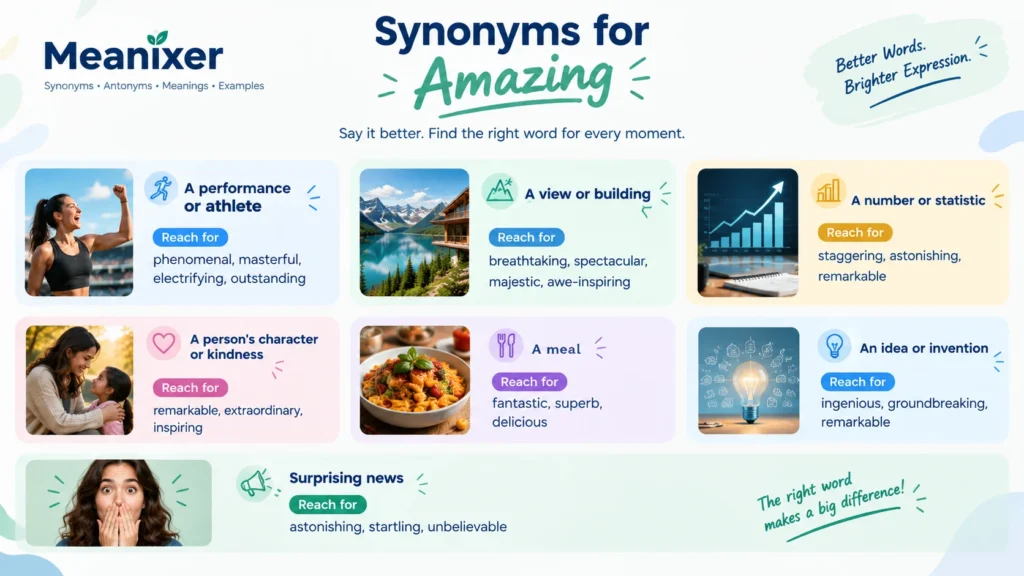
| A performance or athlete | phenomenal, masterful, electrifying, outstanding |
| A view or building | breathtaking, spectacular, majestic, awe-inspiring |
| A number or statistic | staggering, astonishing, remarkable |
| A person’s character or kindness | remarkable, extraordinary, inspiring |
| A meal | fantastic, superb, delicious |
| An idea or invention | ingenious, groundbreaking, remarkable |
| Surprising news | astonishing, startling, unbelievable |
How strong is each word? A rough ladder
Rankings are a judgment call and sources differ, so use this as a guide.
- Mild: good, nice, great
- Medium: wonderful, excellent, impressive, fantastic
- Strong: incredible, remarkable, extraordinary, fabulous, terrific
- Very strong: astonishing, astounding, spectacular, breathtaking, phenomenal
- Maximum: staggering, stupendous, mind-blowing, jaw-dropping
Casual or formal?
- Casual: awesome, fab, fantastic, fabulous, terrific, mind-blowing
- Neutral: incredible, remarkable, impressive, striking
- Formal or academic: extraordinary, exceptional, outstanding, remarkable
For IELTS or other exam writing, use the formal group and skip awesome and fab.
If you mean the verb “to amaze”
Merriam-Webster compares the verbs this way, in paraphrase:
- Surprise: it stresses an effect caused by the unexpected, which isn’t necessarily unusual or new.
- Astonish: surprising so greatly that it seems incredible.
- Astound: it stresses the shock of the astonishment.
- Amaze: it suggests an effect of bewilderment.
- Flabbergast: thorough astonishment and bewilderment, or even dismay.
Where These Words Came From: From Fear To Praise
This is the part most lists skip, and it’s the most interesting. Many of our praise words started out meaning something frightening.
Amazing is a good place to start. In the early 15th century it meant “stupefying,” and by the 1590s it also meant “dreadful.” The “wonderful” sense is recorded from 1704. The verb is even stranger: to amaze was literally to put into a maze, and earlier forms meant stunned, dazed, or bewildered.
Astonish meant to be struck senseless. It comes from Old French and a Latin root for “thunder,” so it literally means to leave someone thunderstruck.
Awesome went the full distance. In the 1590s it meant “deeply respectful,” then “inspiring awe or fear” in the 1670s. The casual “impressive, very good” sense appeared in 1961 and became popular after about 1980. Meanwhile, Mental Floss notes that awful moved in the opposite direction while awesome was heading from dread to praise.
Terrific once meant exactly what it sounds like. In the 1660s it meant frightening, and the informal sense of “excellent” appears in 1888. Tremendous followed a similar path: in the 1630s it meant dreadful, and from 1812 it was used for something extraordinarily large or good.
Fabulous started out in myth. In the early 15th century it meant “mythical, legendary,” by about 1600 it meant “incredible,” and by the 1950s it had been trivialized to “marvelous, terrific.” The slang fab was recorded by 1957 and popularized with The Beatles around 1963. Fantastic began as “existing only in imagination,” and the “wonderful” sense is recorded by 1938.
Stupendous is a cousin of stupid. Both come from a Latin verb meaning to be stunned or struck senseless.
The pattern is that people reach for words of terror and unreality when something overwhelms them, and over time those words wear down into everyday praise.
Traps to avoid
1. The two-meanings trap.
“The report was amazing” could mean surprising or excellent. If it matters, pick a word that settles it: astonishing for surprise, outstanding for quality.
2. The negative-drift trap.
Some strong words lean negative. Startling describes something so sudden or different that it causes a moment of shock or alarm. Staggering can describe a debt as easily as a triumph. Incredible literally means unbelievable, so in careful writing “incredible claims” can sound like doubt.
3. The fashion trap.
Praise words go in and out of style. Fowler’s usage guide, in its 1965 revision, listed fabulous and fantastic among words people use for a time to express high commendation and then tire of, alongside topping, spiffing, ripping, wizard, super, and smashing. Overuse wears any of them out.
4. The register trap.
Awesome, fab, and mind-blowing are fine in a text to a friend, but not in a cover letter or an essay.
Don’t swap the word, show the thing
Replacing amazing with incredible changes the label, not the picture. Compare:
- Flat: “The performance was amazing.”
- Swapped: “The performance was incredible.”
- Specific: “She held the last note until the whole room went silent.”
The last version needs no praise word at all.
Antonyms of amazing
- For the excellence sense: ordinary, unremarkable, mediocre, forgettable, run-of-the-mill. Underwhelming is a neat modern opposite.
- For the surprise sense: expected, predictable, unsurprising.
Quick check
- Which fits best: “a ___ view over the bay”? staggering / breathtaking / startling
- Which of these once meant “frightening”? terrific / ordinary / wonderful
- “The ___ cost of the repairs shocked everyone.” Which word suits a surprisingly large amount? spectacular / staggering / dazzling
Answers: 1) breathtaking. 2) terrific. 3) staggering.
FAQ
What is a stronger word than amazing?
Astounding, staggering, stupendous, and breathtaking. Which fits depends on whether you mean surprise, size, or beauty.
What’s a formal word for amazing?
Extraordinary, exceptional, remarkable, or outstanding.
What’s a casual or slang word for amazing?
Awesome, fab, fantastic, or mind-blowing.
What can I say instead of “amazing” in an email or at work?
Outstanding, exceptional, impressive, or excellent. Name the specific thing too (“your analysis was exceptionally clear”).
Is “amazing” overused?
Often, yes. It covers two meanings and is used for everything from pizza to physics. A more specific word, or a concrete detail, usually lands better.
What is the opposite of amazing?
Ordinary, mediocre, or unremarkable for quality. Expected or predictable for surprise.
Related reading: Synonyms for Beautiful · Synonyms and Antonyms: The Full Guide · Try the Finder Tool

Leave a Reply