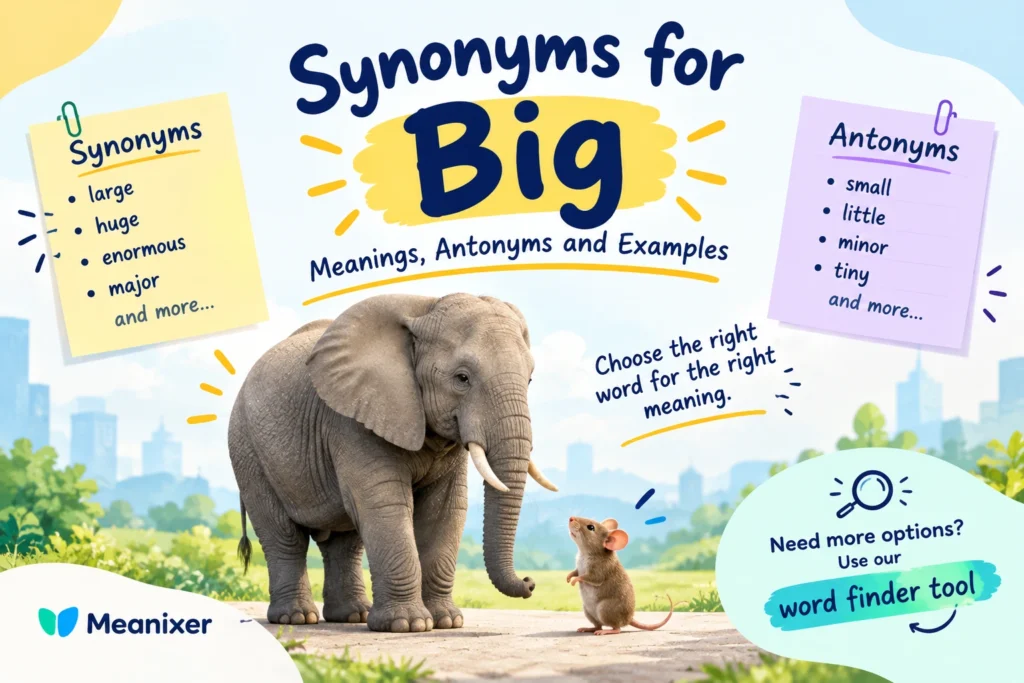
Big is an adjective that means large in size, amount, or importance. It can also mean older, as in a big sister. Common synonyms include large, huge, enormous, and major. Common opposites are small, little, and minor. Use big in everyday speech and casual writing.
What does “big” mean?
Big means large in size, amount, or importance. It is mainly an adjective, and it is pronounced /bɪɡ/.
Dictionaries list several senses:
- Large in size: a big house
- Large in amount or number: a big crowd
- Important or serious: a big decision (see our guide to another word for important)
- Older: my big brother
Big also works as an informal adverb, as in “think big.” It is rare as a noun.
Where does the word “big” come from?
Big comes from Middle English. Its deeper roots are unclear.
Middle English is the form of English used before about 1500. Dictionaries treat the earlier history of big as uncertain. The word has stayed a basic English adjective for centuries.
How do you use “big” in a sentence?
Use big for size, amount, importance, or age. It fits texting, social media, and speech.
Texting
- “Big news! I got the job.”
- “Thanks for the lift. That was a big help.”
Social media
- “Big congrats to the whole team on the launch!”
- “This is a big win for our small shop.”
Spoken conversation
- “That is a big house for two people.”
- “My big sister lives in another city.”
- “Don’t worry. It’s no big deal.”
- “The company made a big change to its plan.”
What are synonyms for big?
The best synonyms for big are large, huge, enormous, and major. Choose by meaning: size, amount, or importance.
| Word | Nuance | Example sentence |
|---|---|---|
| Large | Neutral and slightly formal | We need a large table. |
| Huge | Very big, informal | They live in a huge house. |
| Enormous | Much bigger than normal | An enormous wave hit the shore. |
| Giant | Unusually big for its kind | We saw a giant turtle. |
| Immense | Very great, hard to measure | The team faced immense pressure. |
| Massive | Big and heavy | A massive rock blocked the road. |
| Substantial | Formal, large in amount | She earned a substantial profit. |
| Considerable | Formal, fairly large | The delay caused considerable cost. |
| Major | Important | It was a major decision. |
| Significant | Important and noticeable | Sales showed a significant rise. |
| Great | Large or important | It was a great success. |
| Humongous | Playful, very informal | That is a humongous pizza! |
Want a word to praise something? Try the synonyms for amazing. Talking about a big mistake? See another word for bad.
What are antonyms for big?
The most common antonym of big is small. Other opposites are little, tiny, and minor.
| Word | Nuance | Example sentence |
|---|---|---|
| Small | The standard opposite | She lives in a small town. |
| Little | Small, often friendly in tone | He has a little dog. |
| Tiny | Very small | A tiny bug sat on the leaf. |
| Compact | Small and well designed | We bought a compact car. |
| Slight | Small in degree | There was a slight delay. |
| Minor | Small in importance | It was only a minor problem. |
| Trivial | Too small to matter | Don’t worry about trivial details. |
For importance, you can also read our list of antonyms for important.
Big vs. large: what is the difference?
Big and large mean almost the same thing. Big is more casual, and large is more formal.
| Big | Large | |
|---|---|---|
| Tone | Casual | Neutral to formal |
| Typical use | Speech, texts, stories | Reports, sizes, quantities |
| Example | A big dog | A large number of people |
| Other senses | Older, important | Rarely used for age |
You can say “my big sister” but not “my large sister.” You can say “a large number” but not “a big number of people.”
When should you NOT use “big”? Common mistakes
Avoid big in formal writing, in fixed phrases that use another word, and in comparisons.
- Using big in formal reports. It sounds vague. Write “a significant increase,” not “a big increase.”
- Mixing up big and large with quantities. Wrong: “a big number of students.” Correct: “a large number of students.”
- Wrong comparisons. Wrong: “more big.” Correct: “bigger.” Wrong: “most big.” Correct: “biggest.”
- Using big in set phrases. Wrong: “a big pleasure.” Correct: “a great pleasure.”
Another tip: strong words lose power when you repeat them. If you want variety, see our guide to synonyms for different.
FAQ
What is the best synonym for big?
Large is the best all-purpose synonym for big. It means the same thing in most cases, and it sounds more formal. Use large in school essays, reports, and business emails. Use big in casual talk, texts, and social media posts. Both words describe size, amount, and degree.
What is another word for “big deal”?
A big deal is something important. Good alternatives include major event, important matter, or significant issue. In casual speech, people say “a huge deal.” The phrase “no big deal” means something is not important or not a problem. It is the opposite of a serious matter.
What is the opposite of big?
The most common opposite of big is small. Little and tiny also work for size. For importance, use minor or unimportant. For age, use little or younger, as in “my little brother.” Pick the opposite that matches the meaning of big in your sentence.
Is “big” formal or informal?
Big is neutral. People use it in speech, school, and news. But it can sound vague in formal writing. Replace it with a more exact word, such as significant, substantial, or considerable. These words tell the reader what kind of big you mean, so your writing sounds clearer and more professional.
What does “big sister” mean?
Big sister means an older sister. The word big here shows age or position in the family, not size. A big sister can be small in height. People also use “big brother” the same way. The opposite terms are “little sister” and “little brother.”
What is a stronger word than big?
Huge, enormous, and immense are stronger than big. Gigantic and colossal are stronger still. Use them when something is far larger than normal. Do not use them for ordinary size, because strong words lose their effect when you overuse them.
Can “big” be an adverb?
Yes, in informal English. People say “think big” or “talk big.” Here big means on a large scale or in a boastful way. It is less common than the adjective use, but you will hear it in everyday speech. This use is casual, so avoid it in formal writing.
Quick Quiz
- Which word is the most formal synonym for big: huge, humongous, or substantial?
- Choose the correct sentence: (a) “A big number of fans came.” (b) “A large number of fans came.”
- What does “big” mean in “my big brother”?
Answer key: 1. Substantial. 2. (b). 3. Older.
Conclusion
Big means large in size, amount, or importance, and sometimes older. Choose a more exact synonym, such as large, major, or substantial, when you want your writing to be clearer.
“Need more options than big? Use our word finder tool to find synonyms and similar words for any term.” The line is bold, and “word finder tool”

Leave a Reply