The best synonyms for important are essential, significant, and key.
- Use essential when you can’t do without something. Water is essential for plants.
- Use significant when something has a big effect. This is a significant change.
- Use key when something is the most important part. The key reason is cost.
Important can mean different things. Something can be important because you need it, because it changes things, or because it matters to you. Pick the synonym that matches what you mean.
| If you mean… | Use… | Example |
|---|---|---|
| You need it | essential, vital | “Sleep is vital for your health.” |
| It has a big effect | significant, major | “A major change in the rules.” |
| It comes first | key, main | “The main goal is safety.” |
| It’s urgent | urgent, critical | “This is urgent, so please reply today.” |
| It matters to you personally | meaningful, cherished | “A cherished memory.” |
| It’s a well-known person | influential, prominent | “A prominent doctor.” |
Pick by the kind of important
| The importance is about… | Reach for | Example |
|---|---|---|
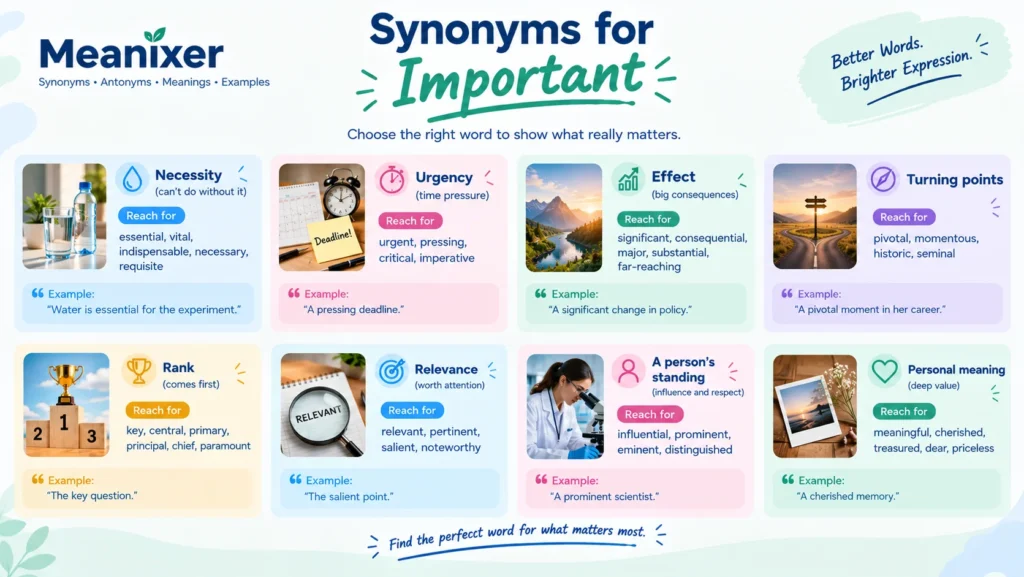
| Necessity (can’t do without it) | essential, vital, indispensable, necessary, requisite | “Water is essential for the experiment.” |
| Urgency (time pressure) | urgent, pressing, critical, imperative | “A pressing deadline.” |
| Effect (big consequences) | significant, consequential, major, substantial, far-reaching | “A significant change in policy.” |
| Turning points | pivotal, momentous, historic, seminal | “A pivotal moment in her career.” |
| Rank (comes first) | key, central, primary, principal, chief, paramount | “The key question.” |
| Relevance (worth attention) | relevant, pertinent, salient, noteworthy | “The salient point.” |
| A person’s standing | influential, prominent, eminent, distinguished | “A prominent scientist.” |
| Personal meaning | meaningful, cherished, treasured, dear, priceless | “A cherished memory.” |
Pick by what you’re describing
| You’re describing… | Reach for |
|---|---|
| A deadline or decision | critical, crucial, pressing, urgent |
| A safety rule or requirement | essential, vital, mandatory, required |
| A discovery or event | significant, historic, momentous, seminal |
| A point in an argument | central, key, salient, relevant |
| A colleague or leader | key, valued, influential, senior |
| A relationship or memory | meaningful, cherished, treasured |
| A task on your to-do list | high-priority, top-priority, pressing |
How strong is each word?
Dictionaries disagree on exact rankings, so treat this as a guide. For example, Thesaurus.com puts critical, crucial, essential, imperative, necessary, urgent, and vital in its strongest tier for the “crucial” sense, and pivotal and pressing lower down.
- Mild: noteworthy, relevant, worthwhile, notable
- Medium: significant, substantial, valuable, key, major
- Strong: critical, crucial, essential, vital, pivotal, consequential
- Maximum: paramount, imperative, indispensable, momentous, all-important, life-and-death
Casual, neutral, formal, or business?
- Casual: big, a big deal, huge, a must
- Neutral: important, significant, major, key, essential
- Formal or academic: crucial, vital, pivotal, substantial, salient, consequential, imperative, paramount
- Business and project work: critical, high-priority, mission-critical, business-critical, time-critical.
Close differences that matter
These are the pairs people mix up. The distinctions come from general usage, so a quick dictionary check is a good idea.
- Essential vs vital: essential means it can’t exist or work without it. Vital adds a sense of life or survival.
- Crucial vs critical: crucial means it decides the outcome. Critical suggests a tipping point and can imply danger.
- Urgent vs important: urgent is about time, and something can be urgent without being important.
- Prominent vs eminent vs influential: prominent stands out, eminent has high standing, and influential affects others.
Why so many of these words are about movement and weight
The history of these words shows that people describe importance in physical terms.
Important literally means “carried in.” It dates from the mid-15th century and comes from Medieval Latin, from Latin importare, “bring in” (in- plus portare, “to carry”). The “pretentious, pompous” sense appeared in 1713. The idea is that something important carries weight into a situation.
Crucial began as an anatomy term. In 1706 it meant cross-shaped, used of the crossing ligaments inside the knee, from Latin crux, “cross.” It’s linked to Francis Bacon’s logical term instantia crucis from 1620, and the extended sense of “central point” is recorded by 1888.
Paramount literally means uphill. It dates from the 1530s, from Old French par amont, “above,” which is equivalent to a Latin phrase meaning “to the hill.”
Salient means leaping. The sense of “prominent, striking” is first recorded in 1840, from the phrase salient point, which referred to an embryo’s heart, which seems to leap. It goes back to Latin salire, “to leap.”
Prominent means jutting out. It comes from Latin prominere, “to project,” and was used for notable people from 1849.
Momentous comes from moment, which has movement at its root. Momentous dates from the 1650s, while moment traces back to Latin momentum, “movement, moving power,” from movere, “to move.”
The pattern: things that matter are carried, crossed, climbed to, leaped at, or jutting out.
Traps to avoid
1. The pompous trap.
Important itself can mean self-important. That sense dates back to 1713, and Merriam-Webster still lists arrogant and proud as senses of the word. Calling a person “important” is usually fine, but when you mean standing or influence, prominent, eminent, or influential are safer.
2. The wrong-word trap.
Some long lists include words that don’t belong. WordHippo’s list for the “crucial significance” context includes words like terrible, dreadful, and awful. Those describe seriousness, not importance. Similarly, Merriam-Webster’s influence list includes notorious, which means prominent for bad reasons.
3. The inflation trap.
If everything is “crucial” or “vital,” nothing is. Save the strong words for things that really are strong.
4. The “importantly” trap.
Writers argue about “more important” versus “more importantly” at the start of a sentence. Dictionary.com notes that both are used in standard English, that more importantly is the more common today, and that some people object to it. Either is acceptable. Choose the one that suits your audience.
5. The register trap.
Mission-critical belongs in a project plan, not a love letter, and a big deal doesn’t belong in a formal report.
Don’t swap the word, show the stakes
Replacing important with crucial changes the label but not the reason.
- Flat: “It is important to sleep well before an exam.”
- Swapped: “It is crucial to sleep well before an exam.”
- Specific: “A tired brain misses the easy marks, so sleep first and cram second.”
Telling readers why something matters often beats any stronger word.
Antonyms of important
The opposite depends on the sense.
- General: unimportant, insignificant, trivial, negligible, minor, trifling, petty
- For necessity: optional, nonessential, inessential, unnecessary
- For rank: secondary, marginal, auxiliary, minor
- For people: unknown, obscure, ordinary, common
- For personal value: meaningless
Quick check
- Which fits best for a deadline that’s tomorrow? urgent / seminal / prominent
- A ___ discovery changed medicine forever. pressing / pivotal / optional
- Which word literally means “uphill” in its roots? crucial / paramount / salient
- What’s the opposite of essential in the necessity sense?
Answers: 1) urgent. 2) pivotal. 3) paramount. 4) optional or nonessential.
FAQ
What is a stronger word than important?
Crucial, vital, essential, paramount, or indispensable.
What’s a formal word for important?
Significant, crucial, pivotal, imperative, or paramount. For academic writing, also substantial or salient.
What can I say at work instead of important?
Key, critical, high-priority, or essential. Add the reason too (“critical because the client launches Monday”).
What’s another word for an important person?
Influential, prominent, eminent, distinguished, or leading.
Is it “more important” or “more importantly”?
Both are used in standard English at the start of a sentence, and more importantly is the more common today.
What’s another word for importance?
Dictionary.com gives concern, weight, and moment as synonyms. Significance and consequence also work. dictionary
What is the opposite of important?
Unimportant, insignificant, trivial, or negligible.
Related reading: Synonyms for Beautiful · Synonyms for Amazing ·· Synonyms and Antonyms: The Full Guide · Try the Finder Tool

Leave a Reply