
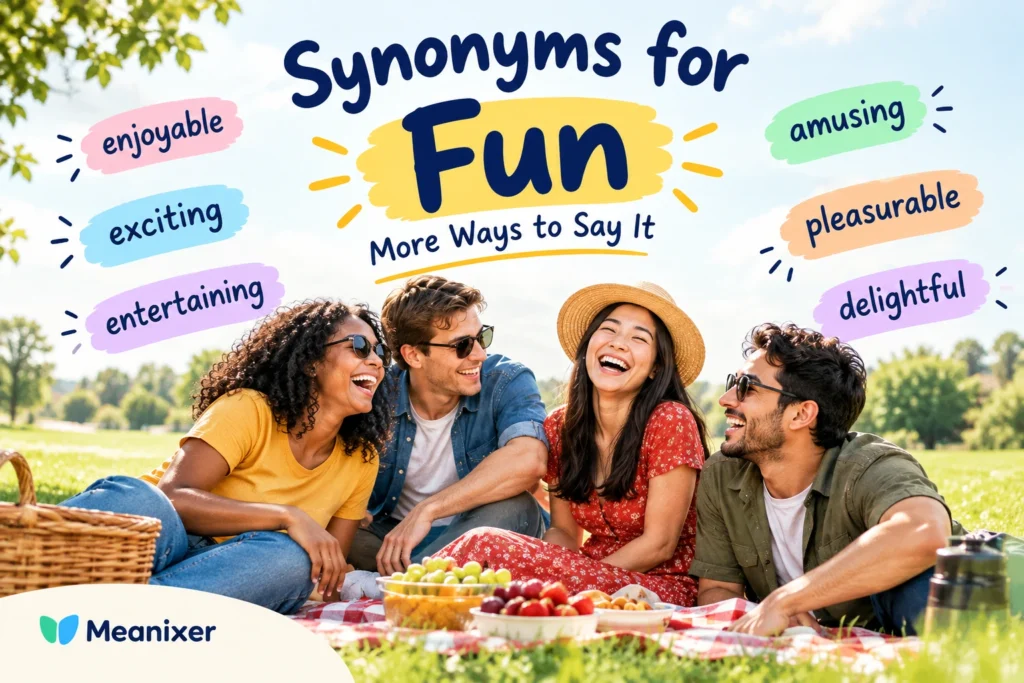
Fun is mainly a noun meaning enjoyment, and it’s also a common adjective.
For an event you liked, use enjoyable or entertaining. For the noun, use amusement or pleasure. For teasing, use tease or mock. Top antonyms: boring, dull, and tedious.
Need more options? Try our synonym and antonym finder.
This guide to synonyms for fun shows which word matches the kind of fun you mean. A quiet picnic, a roller coaster, and a joke at someone’s expense need different words.
Meaning of Fun
Part of speech: noun (main use), adjective, and an informal verb
Pronunciation (US): fuhn, /fʌn/
Definition (noun): Dictionary.com defines it as something that provides mirth or amusement, and also as enjoyment or playfulness.
Definition (adjective): relating to fun, especially social fun, as in “a fun thing to do.” One dictionary site labels this adjective use informal. [Editor: check Merriam-Webster’s label.]
Definition (verb): informal, meaning to joke or kid. It’s rare today.
Word forms: the safe comparison is more fun and most fun. Lists funner and funnest, but another dictionary site calls them nonstandard. Dictionaries disagree, so check your style guide. A related word is funny, which means something different (see below).
Fun in a sentence:
- We had fun at the lake.
- That was a fun trip.
This page covers four senses: (1) enjoyable (adjective), (2) enjoyment (noun), (3) “in fun,” meaning jokingly, and (4) “make fun of,” meaning tease or ridicule. Sense 1 is what most readers mean, so it gets the most depth.
Synonyms for Fun
Synonyms aren’t swappable parts. Each word has its own connotation, the feeling it adds beyond its dictionary meaning. Register means how formal or casual a word sounds. A collocation is a pair of words that often go together, like “have fun.”
Sense 1: Enjoyable (most searched)
Think “a fun party” or “a fun person.” These words differ in kind, so I’m grouping them: for things and events, for people, and for very informal praise.
For things and events
| Word | How it differs | Example |
|---|---|---|
| enjoyable (adj., neutral) | The plain, all-purpose swap. A bit more formal than fun. | The boat tour was an enjoyable way to spend the afternoon. |
| entertaining (adj., neutral) | Holds your attention. One thesaurus notes it’s slightly more formal than fun but still everyday. | The show was entertaining from start to finish. |
| amusing (adj., neutral) | Makes you smile or laugh. It sounds odd for a roller coaster. | Her amusing stories kept everyone laughing. |
| delightful (adj., neutral-formal) | Charming and polished. The same source calls it a bit more sophisticated. | We spent a delightful evening in the garden. |
| pleasant (adj., neutral) | Mild and calm. It sounds odd for a rowdy party. | It was a pleasant walk by the river. |
| thrilling (adj., neutral) | High excitement and adrenaline. It sounds odd for a quiet picnic. | The roller coaster was thrilling. thesaurusthesaurus |
For people
| Word | How it differs | Example |
|---|---|---|
| lively (adj., neutral) | Full of energy. It also describes events. | She’s a lively dinner guest. |
| playful (adj., neutral) | Lighthearted and a little silly, in a good way. | He has a playful sense of humor. |
Very informal
| Word | How it differs | Example |
|---|---|---|
| a blast (noun phrase, informal) | Extremely enjoyable. Not for essays. | The concert was a blast. |
| a riot (noun phrase, informal) | Hilarious and wild. | Our trip with the kids was a riot. |
Energy ladder. This ladder measures one thing: how much energy and excitement the fun carries. The order is rough, because dictionaries don’t rank these words.
pleasant → enjoyable → lively → thrilling
I left off entertaining, amusing, delightful, and playful because they describe the kind of fun, not the energy. I also left off a blast and a riot because they’re informal intensifiers.
Related, not true synonyms: engrossing (it holds your attention but isn’t always fun), wild (it can mean fun or dangerous), and slang like lit or fire. Slang changes fast, so check it before you use it.
Sense 2: Enjoyment (noun)
Think “have fun,” “full of fun,” or “for fun.” Dictionary.com lists gaiety, play, pleasure, and merriment here. dictionary
| Word | How it differs | Example |
|---|---|---|
| enjoyment (noun, neutral) | The plain, direct swap. | She read for pure enjoyment. |
| amusement (noun, neutral) | Light fun, often from something that makes you smile. | The magician’s tricks brought amusement to the crowd. |
| pleasure (noun, neutral) | Broader and can be quiet. | He takes pleasure in quiet mornings. |
| entertainment (noun, neutral) | Fun that a show or person provides. | The hotel offers live entertainment on Fridays. |
| recreation (noun, neutral-formal) | Leisure activities. | The park has space for outdoor recreation. |
| play (noun, neutral) | Activity done for its own sake, often by children. | Children learn through play. |
| merriment (noun, formal-literary) | Cheerful laughter. | Sounds of merriment filled the hall. |
| gaiety (noun, formal-literary, dated) | Lighthearted cheer. | The gaiety of the festival was contagious. |
| good time (noun phrase, informal) | Everyday and friendly. | We had a good time at the lake. |
When you describe how this feeling shows up in you, see our synonyms for happy.
Sense 3: “In fun” (jokingly)
Dictionary.com defines “for fun” and “in fun” as “as a joke; not seriously; playfully.”
| Word | How it differs | Example |
|---|---|---|
| in jest (adv. phrase, formal-literary) | Old-fashioned and a bit stylish. | He spoke only in jest. |
| jokingly (adv., neutral) | Plain and clear. | She jokingly called him the boss. |
| playfully (adv., neutral) | Lighthearted and gentle. | He playfully tapped her shoulder. |
| as a joke (adv. phrase, neutral) | Everyday and direct. | I said it as a joke. |
Sense 4: “Make fun of” (tease or ridicule)
Defines this phrase as making someone the object of ridicule. The words below range from friendly to cruel. Before you choose, decide whether the speaker is kind or unkind.
| Word | How it differs | Example |
|---|---|---|
| rib (verb, informal) | Friendly joking. | His friends ribbed him about his new haircut. |
| kid (verb, informal) | Joke with someone, without meanness. | I’m only kidding. |
| tease (verb, neutral) | Can be affectionate or unkind, so tone matters. | My brothers tease me about my hair. |
| poke fun at (verb phrase, neutral) | Mild mockery, often of an idea or a group. | The show pokes fun at politicians. |
| laugh at (verb phrase, neutral) | Often unkind. “Laugh with” is friendlier. | Don’t laugh at her accent. |
| mock (verb, neutral) | Copies or scorns someone. | Some classmates mocked his accent. |
| ridicule (verb, formal) | Public scorn. | Critics ridiculed the plan. |
| deride (verb, formal) | Treat as worthless, with contempt. | Reviewers derided the film as shallow. |
| taunt (verb, negative) | Insults meant to provoke anger. | Older kids taunted him until he cried. |
Unkindness ladder. This ladder measures one thing: how unkind the words are. The order is rough, because tone and context change everything.
rib → tease → poke fun at → mock → ridicule
I left off kid (not unkind), laugh at (it varies), deride (close to ridicule, only more formal), and taunt (it aims to provoke, not just to belittle).
Being mocked can leave someone feeling low. For words to describe that, see our synonyms for sad.
Specialist uses
In terms like fun run (a casual race) and fun-size, fun works as a label. These have no true synonym, so I’m not forcing one.
Which one should I choose?
- Ask what kind of fun you mean: an enjoyable thing, a feeling, a joke, or teasing.
- Jump to that sense and read the “How it differs” column.
- Check the register. A blast suits friends, and enjoyable suits an essay.
- Check the energy. A quiet picnic is pleasant, and a roller coaster is thrilling.
Antonyms for Fun
Each antonym is paired with the word it contrasts with.
| Antonym | Opposite of | How it differs | Example |
|---|---|---|---|
| boring (adj., neutral) | entertaining, enjoyable | Holds no interest. | The lecture was boring. |
| dull (adj., neutral) | lively | Lacks energy or color. | The party felt dull after midnight. |
| tedious (adj., neutral-formal) | enjoyable, amusing | Long and tiresome. | Filing the forms was tedious. |
| boredom (noun, neutral) | amusement, entertainment | The feeling of having nothing interesting to do. | Boredom set in on the long drive. |
| drudgery (noun, formal) | recreation, play | Dull, hard work. | She escaped the drudgery of data entry. |
| serious (adj., neutral) | playful | Solemn, without play. | He turned serious when the topic changed. |
| in earnest (adv. phrase, formal) | in jest, in fun | Meant seriously. | She spoke in earnest about the risks. |
| praise (verb, neutral) | mock, ridicule | Shows approval, not scorn. | The coach praised the team. |
Near-misses. Funny looks like a relative but isn’t an opposite, so unfunny doesn’t mean boring. Work is often paired with fun, but many jobs are fun, so it isn’t a true opposite. Likewise hard and difficult aren’t opposites, because a hard challenge can still be enjoyable. One thesaurus offers serious, sober, and unplayful as opposites of playful, which matches the serious row above.
Fun vs. Similar Words
| Pair | Key difference | Example |
|---|---|---|
| fun vs. funny | Fun means enjoyable. Funny means amusing, or sometimes strange. | A fun party; a funny joke. |
| fun vs. enjoyable | Enjoyable is more formal and always an adjective. | A fun trip; an enjoyable trip. |
| fun vs. play | Merriam-Webster says the two are roughly equivalent in some situations. Play stresses activity for its own sake. | Children learn through play. merriam-webster |
Preposition and phrase patterns:
| Phrase | Meaning | Example |
|---|---|---|
| have fun with | enjoy something | The kids had fun with the paints. |
| make fun of | ridicule | Don’t make fun of his accent. |
| fun for | suited to an audience | It’s a fun show for kids. |
| for fun | with no serious purpose | We play cards for fun. |
| in fun | as a joke | His insults were only in fun. |
Using Fun and Its Synonyms in Context
- Formal: The festival offers a delightful evening for families.
- Casual: That concert was a blast.
- Academic: Children learn through play and recreation.
- Review writing: The film is entertaining, if a little long.
- Technical: Our designers test whether a game feels fun.
Collocations: have fun, good clean fun, for fun, full of fun, a lot of fun. “Good clean fun” is more natural than “good clean amusement.” For a fun trip, see synonyms for experience.
Common Mistakes
Common mistakes box
- Mixing up fun and funny. “The party was funny” means it made you laugh, or was odd. Say “fun.”
- “More funner.” This double comparative is a real error. Say “more fun.”
- Using funner or funnest in formal writing. Dictionaries disagree, so choose more fun and most fun.
- Overusing the adjective in essays. “A fun trip” is common in speech. In essays, try enjoyable or delightful.
- Confusing “make fun of” with “have fun with.” The first mocks someone. The second means enjoying something together.
- Repeating fun everywhere. Other overused words have the same fix.
Related Words, Idioms, and Word Origin
Related words: funny, fun run, fun-size, fun-filled.
Idioms and fixed phrases:
- For fun means with no serious purpose.
- Poke fun at means to tease gently.
- Fun and games is often used facetiously for ordinary activity. Dictionary.com labels it facetious. dictionary
- Figure of fun (mainly British) means someone people laugh at.
- More fun than a barrel of monkeys (informal) means very fun.
Etymology (word origin): one thesaurus says fun comes from the obsolete fon, meaning “to act the fool” or “to make a fool of.”
Did you know? The word started out close to “making a fool of someone.” That’s why make fun of still carries a sting today.
FAQs
What are the best synonyms for fun?
It depends on the sense. Use enjoyable or entertaining for an event, amusement or pleasure for the noun, and tease or mock for “make fun of.”
What is another word for fun as an adjective?
Try enjoyable, entertaining, amusing, or delightful. For high energy, use thrilling or lively.
What is another word for a fun person?
Use lively or playful. For a very casual tone, you could say someone is a riot.
What is a more formal word for fun?
Use enjoyment, amusement, or recreation for the noun, and enjoyable or delightful for the adjective.
What is the opposite of fun?
Boring, dull, and tedious are the usual opposites for the adjective. For the noun, use boredom or drudgery.
What is another way to say “make fun of”?
Use tease for mild teasing, mock or ridicule for scorn, and taunt for insults meant to provoke.
Is “funner” a word?
It’s contested. Dictionary.com lists it, while another dictionary site calls it nonstandard. In formal writing, use more fun.
Quick Quiz
- Which word best replaces fun in “The museum tour was fun,” in a school essay?
a) enjoyable b) boring c) tedious d) dull - Which phrase is an informal way to say “very fun”: “The party was a ___”?
a) blast b) boredom c) drudgery d) jest - Which verb is the mildest in “My brothers love to ___ me about my hair”?
a) tease b) deride c) ridicule d) taunt - Which word is an opposite of amusement?
a) boredom b) pleasure c) merriment d) play - Which phrase can replace in fun in “His insults were only in fun”?
a) in jest b) in earnest c) in a blast d) in drudgery
Mini-challenge: Rewrite with a more formal synonym: “The trip was a fun experience.”
Answers: 1) a. 2) a. 3) a. 4) a. 5) a. Mini-challenge: “The trip was an enjoyable experience.” (Delightful also works.)
Conclusion
Choose by sense first, then by energy and tone. Use enjoyable for an essay, amusement for the noun, and tease for a friendly joke.

Leave a Reply