
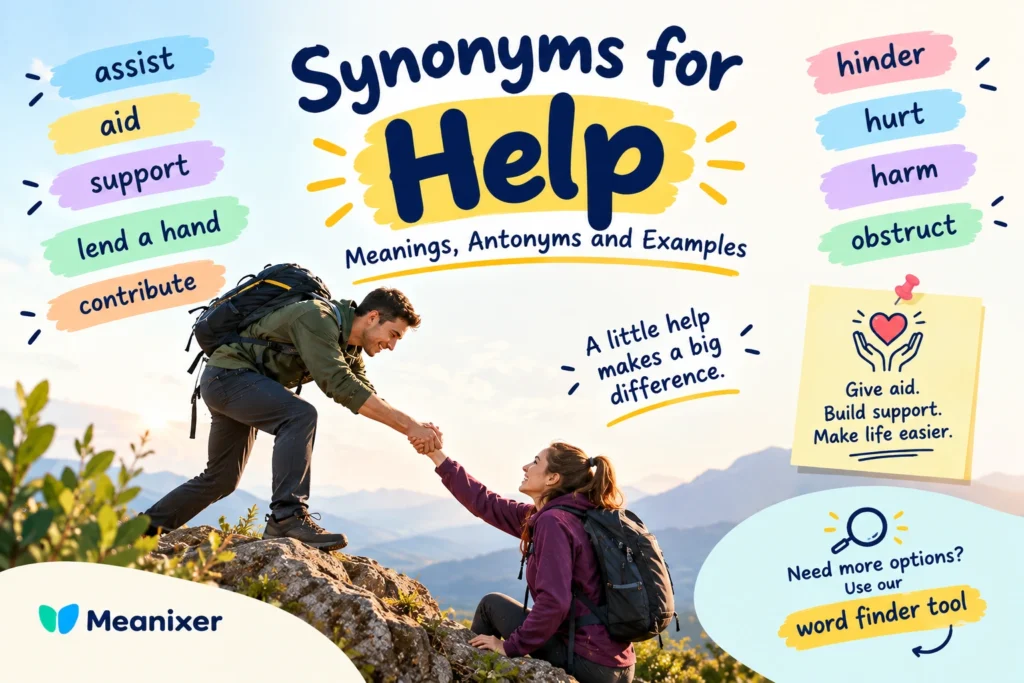
Help is a verb and a noun. As a verb, it means to make something easier or possible for someone. As a noun, it means aid or support. Common synonyms include assist, aid, and support. Common opposites are hinder, hurt, and obstruct. Use help in everyday speech and writing.
What does “help” mean?
Help means to give someone aid or make a task easier. It is a verb and a noun, and it is pronounced /hɛlp/.
Dictionaries list several senses:
- Verb: to give aid. She helps her mother cook.
- Verb: to make something better or easier. A warm drink helps a sore throat.
- Verb: to avoid or stop. I can’t help laughing.
- Verb: to serve yourself. Help yourself to some tea.
- Noun: aid or support. I need some help.
- Noun: a person or thing that aids. She was a great help.
Help is also an interjection. People shout “Help!” in an emergency. Related words include helper, helpful, and helpless.
Where does the word “help” come from?
Help comes from Old English helpan. Similar words exist in other Germanic languages.
Old English was the form of English used in England before about 1100. The German word helfen has the same meaning. Dictionaries treat help as a very old, basic English word. It has kept its core meaning for centuries.
How do you use “help” in a sentence?
Use help for aid, support, or making something easier. It fits texting, social media, and speech.
Texting
- “Can you help me move on Saturday?”
- “Thanks for your help today!”
Social media
- “Need help with your resume? Send me a message.”
- “This tip really helped me save time.”
Spoken conversation
- “Let me help you with those bags.”
- “Do you need any help?”
- “I can’t help it. That joke is funny.”
- “Please help yourself to some food.”
What are synonyms for help?
The best synonyms for help are assist, aid, and support. Choose by tone: formal, casual, or emotional.
| Word | Nuance | Example sentence |
|---|---|---|
| Assist | Formal verb, often for tasks | Nurses assist the doctor. |
| Aid | Formal, often for emergencies | The group aids flood victims. |
| Support | Ongoing help, practical or emotional | Her family supports her. |
| Lend a hand | Casual phrase | Can you lend a hand? |
| Pitch in | Casual, joining a group effort | Everyone pitched in to clean. |
| Back | Informal, support a person or plan | We back your idea. |
| Contribute | Add something to a shared goal | She contributed to the project. |
| Facilitate | Formal, make a process easier | Software facilitates teamwork. |
| Relieve | Ease pain or stress | This cream relieves itching. |
| Benefit | Be useful to someone | The new rule benefits students. |
| Serve | Be useful or provide a service | The tool serves many users. |
| Assistance | Formal noun | Thank you for your assistance. |
Need more options than help? Use our word finder tool to find synonyms and similar words for any term.
Want a word to thank someone? See the synonyms for amazing. Talking about a shared task? Try another word for create.
What are antonyms for help?
The most common antonym of help is hinder. Other opposites are hurt, harm, block, and obstruct.
| Word | Nuance | Example sentence |
|---|---|---|
| Hinder | Make something slower or harder | Rain hindered the search. |
| Hamper | Limit progress | Poor tools hamper our work. |
| Obstruct | Block the way | Trees obstructed the road. |
| Impede | Slow down, formal | Noise impedes learning. |
| Hurt | Cause pain or damage | Lies hurt trust. |
| Harm | Cause damage | Smoking harms your health. |
| Undermine | Weaken in secret | Gossip undermines a team. |
For the opposite of a useful thing, you can also read our list of antonyms for important.
Help vs. assist: what is the difference?
Help and assist mean almost the same thing. Help is casual, and assist is more formal.
| Help | Assist | |
|---|---|---|
| Tone | Casual to neutral | Formal |
| Typical use | Speech, texts, daily life | Reports, service, work |
| Example | Help me find my keys. | Staff will assist you. |
| Noun form | Help | Assistance |
Assist often suggests you support the main person. Help works for both small and large tasks. In daily talk, “help” sounds more natural.
When should you NOT use “help”? Common mistakes
Avoid help in the wrong grammar pattern or the wrong tone. Fix these four common mistakes.
- Using helpful as a noun. Wrong: “Thanks for your helpful.” Correct: “Thanks for your help.”
- Adding “to” after help. Wrong: “Can you help to me?” Correct: “Can you help me?”
- Using the wrong verb form after “can’t help.” Wrong: “I can’t help to laugh.” Correct: “I can’t help laughing.”
- Using a formal word in casual talk. Wrong: “Please aid me with homework.” Correct: “Please help me with my homework.”
If you want to describe a rich life, see our guide to synonyms for experience. To link ideas in your writing, try the synonyms for also.
FAQ
What is the best synonym for help?
Assist is the best all-purpose synonym for help as a verb. It means the same thing in most cases, and it sounds more formal. Use assist in business emails and service writing. Use help in casual talk and texts. For the noun, use assistance or support.
What is another word for “help out”?
Help out means to give someone a hand with a task. Good alternatives are pitch in, lend a hand, and chip in. These phrases sound casual and friendly. Pitch in suggests a group effort. Chip in usually means sharing a cost or effort. Use them in speech and informal writing.
What is the opposite of help?
The most common opposite of help is hinder. It means to make something harder to do. Other opposites are hurt, harm, block, and obstruct. Pick the one that fits your meaning. Hinder fits delays. Harm fits damage. As a noun, the opposite is hindrance.
Is it “help me” or “help to me”?
Say “help me.” Help takes a direct object, so you do not need “to.” Correct: “Can you help me?” Wrong: “Can you help to me?” You can say “help me with this” or “help me understand.” After help, the next verb can also take “to.”
What does “can’t help it” mean?
Can’t help it means you cannot stop yourself or control something. For example, “I can’t help laughing” means you cannot stop laughing. “I can’t help it” can also mean it is not your fault. “Can’t help but” plus a verb has the same meaning in speech.
What is a formal word for help?
Assist, aid, and facilitate are formal words for help. Assistance is a formal noun. Use them in reports, emails, and official writing. Facilitate means to make a process easier, and it does not take a person as its object. Aid often suggests emergency or charity help.
Is “help” a noun or a verb?
Help is both a verb and a noun. As a verb: “Please help me.” As a noun: “I need some help.” It can also be an interjection, as in “Help!” Related words include helper, helpful, and helpless. These words change the part of speech, but they share the same root.
Quick Quiz
- Which word is the most formal synonym for help: pitch in, assist, or lend a hand?
- Choose the correct sentence: (a) “Thank you for your helpful.” (b) “Thank you for your help.”
- Which word is an antonym of help: aid, hinder, or support?
Answer key: 1. Assist. 2. (b). 3. Hinder.
Conclusion
Help means to give aid or make something easier, and it is also the word for the aid itself. Choose assist, support, or lend a hand to match your tone. For more ideas, see another word for meaningful.

Leave a Reply