
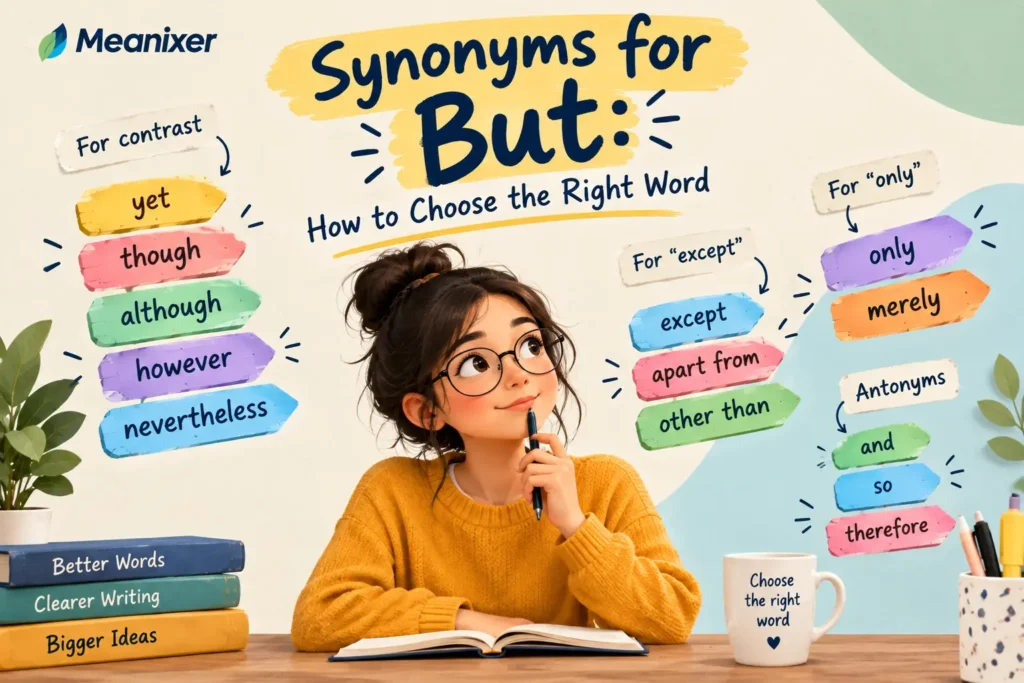
But is a conjunction that joins two ideas that contrast. It also means “except” and “only,” so pick by sense.
For contrast, use yet, though, or however. For “except,” use apart from. For “only,” use merely.
Top antonyms: and, so, and therefore.
Need more options? Try our synonym and antonym finder.
This guide to synonyms for but shows which word fits which job. One teaching site calls but one of the most overused words in English, so a few good alternatives will help your writing.
Meaning of But
Part of speech: conjunction (main use), preposition, adverb, and noun
Pronunciation (US): /bʌt/
Definition: as a conjunction, it introduces something that contrasts with what you just said. As a preposition, it means “except.” As an adverb, it means “only.”
Word forms: the noun has a plural, buts. The word has no other endings.
But in a sentence:
- The room is small but bright.
- Everyone but Maya came.
This page covers five senses: (1) contrast, (2) “except,” (3) “only,” (4) the noun meaning “objection,” and (5) the phrase all but.
Synonyms for But
Synonyms aren’t swappable parts. Each word has its own connotation, the feeling it adds beyond its dictionary meaning. Register means how formal or casual a word sounds. A collocation is a pair of words that often go together, like “nothing but.”
Sense 1: Contrast (most searched)
But is a conjunction, so it joins clauses. Some alternatives work the same way, and others are adverbs that need new punctuation. But and however belong to different word classes, so swapping them changes your punctuation.
| Word | How it differs | Example |
|---|---|---|
| yet (conj., neutral-formal) | A little more formal. It often hints at a surprise. | The room is small yet bright. |
| though (conj. or adv., informal-neutral) | At the end of a sentence it acts like a soft “but.” | The food was great. The service was slow, though. |
| although (conj., neutral) | Starts a clause, so you rebuild the sentence. | Although the room is small, it’s bright. |
| while (conj., neutral) | Sets two facts side by side. It also means “during,” so context matters. | Some students prefer notes, while others prefer videos. |
| whereas (conj., formal) | Compares two facts in a formal tone. | The first plan is cheap, whereas the second is fast. |
| however (adv., neutral-formal) | Needs a semicolon or period before it. | The room is small; however, it’s bright. |
| still (adv., neutral) | Warmer. It starts a new sentence. | The room is small. Still, I love it. |
| nevertheless (adv., formal) | The second point holds despite the first. “I like the plan; nevertheless, it costs too much” sounds odd. | The weather was cold; nevertheless, we hiked. |
| even so (adv. phrase, neutral) | The same idea in everyday words. | The hike was hard. Even so, we finished. |
Formality ladder. This ladder measures one thing: how formal the word sounds. The order is rough, because dictionaries don’t rank these words.
but → still → however → nevertheless
I left off yet, though, although, while, and whereas because their formality shifts with their place in the sentence. I also left off even so because it’s a phrase.
Related, not true synonyms: except that (adds an exception to a claim), only (an informal conjunction, as in “I’d go, only I’m busy”), and instead (replaces one thing with another).
For the full list of concession words, see our synonyms for however.
Sense 2: “Except”
Think “everyone but me.” Here but is a preposition. In this sense, the pronoun after it takes the objective form: but him, but her. Usage varies, so check your style guide.
| Word | How it differs | Example |
|---|---|---|
| except (prep., neutral) | The plain choice. | Everyone except Maya came. |
| except for (prep. phrase, neutral) | Often starts a sentence. | Except for the noise, the hotel was great. |
| apart from (prep. phrase, neutral) | It can also mean “in addition to,” so context decides. | Apart from two students, everyone passed. |
| aside from (prep. phrase, neutral, US) | The same, and common in US writing. | Aside from the cost, the plan works. |
| other than (prep. phrase, neutral) | Often follows nothing, no one, or anything. | No one other than Dev knew the answer. |
| save for (prep. phrase, formal-literary) | Old-fashioned. It suits literary writing. | The town was silent save for the wind. |
| with the exception of (prep. phrase, formal) | Wordy. It fits official writing. | All items, with the exception of sale goods, can be returned. |
| excluding (prep., neutral-formal) | Common with prices and totals. It sounds odd for people. | The total is $80, excluding tax. |
| bar (prep., informal-neutral, mainly British) | Short and breezy. | All bar one student passed. |
Sense 3: “Only” or “merely”
Think “She was but a child.” Vocabulary.com defines this adverb use as “and nothing more.” It sounds formal and a bit literary today. Common pairings include but a moment and but a few. vocabulary
| Word | How it differs | Example |
|---|---|---|
| only (adv., neutral) | The plain choice. | She was only a child. |
| merely (adv., neutral-formal) | Adds a belittling tone. | It was merely a suggestion. |
| just (adv., informal-neutral) | Casual and common in speech. | It’s just a scratch. |
| simply (adv., neutral) | Often means “plainly,” so it fits only some sentences. | He was simply tired. |
| no more than (phrase, neutral-formal) | Precise about amounts. | The trip took no more than an hour. |
Sense 4: Noun, “an objection”
Think “no buts about it.” The plural is buts.
| Word | How it differs | Example |
|---|---|---|
| objection (noun, neutral) | A direct disagreement. | She raised one objection. |
| reservation (noun, neutral-formal) | A doubt you hold back. | I have a reservation about the date. |
| caveat (noun, formal) | A warning attached to a deal. | The offer has one caveat: you must pay upfront. |
Sense 5: All but (almost)
Before an adjective or verb, all but means “almost.” Before a noun or number, it means “all except,” as in “all but one.”
| Word | How it differs | Example |
|---|---|---|
| almost (adv., neutral) | The plain choice. | The tank was almost empty. |
| nearly (adv., neutral) | Close to a point, but not quite. | We nearly missed the train. |
| virtually (adv., neutral-formal) | Practically the same as. | The road is virtually empty at night. |
Which one should I choose?
- Ask what but is doing: contrasting, excluding, meaning “only,” naming an objection, or meaning “almost.”
- Jump to that sense and read the “How it differs” column.
- Check the register. Still suits blogs, and whereas suits reports.
- Check the grammar. However and nevertheless need a semicolon or period. Although needs a rebuilt sentence.
Antonyms for But
In the contrast sense, an antonym joins ideas that agree or follow. Each antonym is paired with the word it contrasts with. The “only” and “all but” senses have no true antonym.
| Antonym | Opposite of | How it differs | Example |
|---|---|---|---|
| and (conj., neutral) | but, yet | Adds an idea that agrees. | The soup is hot and tasty. |
| so (conj., informal-neutral) | but | Shows a result. | It was late, so we left. |
| therefore (adv., formal-neutral) | however | Shows a result in a formal tone. | The road was closed; therefore, we took the bus. |
| including (prep., neutral) | except, apart from | Counts something in. | Everyone, including Sam, came. |
| in addition to (prep. phrase, neutral-formal) | except for | Adds, instead of excluding. | In addition to Maya, Dev came. |
| approval (noun, neutral) | objection | Agreement, not disagreement. | The plan won quick approval. |
Near-misses. Also adds an idea but doesn’t say whether it agrees. Because gives a reason, so it isn’t an opposite. Or offers a choice. In “not only X but also Y,” but adds an idea instead of contrasting, so and isn’t its opposite there. For more result words, see our antonyms for however.
But vs. Similar Words
| Pair | Key difference | Example |
|---|---|---|
| but vs. however | But joins clauses. However is an adverb, so it needs a semicolon or period before it. | It’s cheap, but slow. / It’s cheap; however, it’s slow. |
| but vs. yet | Yet is more formal and often hints at surprise. | Small yet strong. |
| but vs. although | Although starts the clause and takes no but. | Although it’s cheap, it’s slow. |
Preposition and phrase traps:
| Phrase | Meaning | Example |
|---|---|---|
| everyone but her | everyone except her | Everyone cheered but her. |
| all but finished | almost finished | The report is all but finished. |
| but for the rain | if it weren’t for the rain | But for the rain, we’d have gone. |
| nothing but | only | He ate nothing but fruit. |
Using But and Its Synonyms in Context
- Formal: The study is small yet well designed.
- Casual: I’d go, but I’m wiped out.
- Academic: All the participants, apart from two, completed the survey.
- Business: We approve the plan, with one reservation.
This word has no real technical sense, so I skipped that example type. For strong adjectives in essays, see synonyms for important.
Collocations: nothing but, all but, anything but, but then, but for.
Common Mistakes
Common mistakes box
- “Although… but.” “Although it’s cheap, but it’s slow” is a real error. Use one: Although it’s cheap, it’s slow or It’s cheap, but it’s slow.
- “But however.” It repeats the same job. Choose one.
- Mixing up all but and everyone but. All but finished means almost finished. Everyone but Sam means all except Sam.
- Pronoun case. In the “except” sense, but is a preposition, so many writers say “everyone but him.” Check your style guide.
- Never starting a sentence with but. Dictionary.com says but often begins sentences as a transitional word. Some teachers disagree, so check your style guide. dictionary
Repetition is a problem with many words. For another example, try synonyms for bad when “very bad” gets old.
Related Words, Idioms, and Word Origin
Related words: and, or, yet, so, however, although, except.
Idioms and fixed phrases:
- All but means “almost.”
- Nothing but means “only.”
- Anything but means “not at all,” as in “The test was anything but easy.”
- But for means “were it not for.”
- Last but not least introduces a final item that matters.
- No ifs, ands, or buts (informal) means “no excuses.”
Etymology (word origin): The noun use of but to the early 1700s. For the root of the conjunction,
Did you know? But is one of seven coordinating conjunctions in English: for, and, nor, but, or, yet, so. Teachers often use the memory trick FANBOYS for it. For another contrast word, see our synonyms for different.
For definitions and usage notes, check Merriam-Webster [link to add] or Oxford Learner’s Dictionaries [link to add].
FAQs
What is another word for but?
It depends on the sense. Use yet, though, or however for contrast, apart from for “except,” and merely for “only.”
What is a formal word for but?
Use however, nevertheless, or whereas. Yet is also more formal than but.
What can I say instead of but at the start of a sentence?
Try However, Still, Even so, or Yet.
What is the opposite of but?
And is the closest opposite when you add an idea. So and therefore are opposites when you show a result.
Is but the same as however?
They’re close in meaning but differ in grammar. But is a conjunction, and however is an adverb. That changes the punctuation.
What does “all but” mean?
Before an adjective or verb, it means “almost,” as in “all but finished.” Before a noun or number, it means “all except,” as in “all but one.”
Can you start a sentence with but?
Yes. It’s a common transition, though some teachers discourage it, so follow your style guide.
Quick Quiz
- Which word best replaces but in “The room is small but bright”?
a) yet b) except c) merely d) therefore - Which phrase can replace but in “Everyone but Tom arrived on time”?
a) apart from b) all but c) merely d) therefore - Which word best replaces but in “She was but a child”?
a) merely b) except c) however d) so - In “He was all but finished,” what does all but mean?
a) almost b) except c) never d) merely - Which word shows a result instead of contrast: “It was late, ___ we left”?
a) yet b) so c) though d) while
Mini-challenge: Rewrite with a more formal synonym: “I like the plan, but it costs too much.”
Answers: 1) a. 2) a. 3) a. 4) a. 5) b. Mini-challenge: “I like the plan; however, it costs too much.”
Conclusion:
Choose by sense, then grammar, then register. Use yet for a formal contrast, apart from for “except,” and merely for “only.”
Want more help with connecting words? Browse our Meanixer.com for the full library.

Leave a Reply