
If you’re looking for another word for sad, the best choice depends on how someone feels and how strongly they feel it. Use unhappy for general sadness, downhearted for low spirits, heartbroken for deep emotional pain, or miserable for intense unhappiness. The right synonym makes your writing more precise and natural.
Sad synonyms and antonyms help you describe feelings more precisely. The best alternatives include unhappy for general sadness, downhearted for low spirits, gloomy for a dark or pessimistic mood, sorrowful for deep sadness, and heartbroken for intense emotional pain. Common antonyms include happy, cheerful, and joyful, each expressing a different kind of happiness.
Meaning of Sad
Part of speech: Adjective
Pronunciation: /sæd/ — rhymes with bad, mad, and glad.
Definition: Sad means feeling or showing unhappiness, sorrow, or regret. It can describe a person’s feelings, an event that causes pain, or something that creates a sense of loss.
The word has several uses. You might feel sad after receiving disappointing news, describe a sad movie that makes people cry, or call an event sad because it causes suffering. This guide focuses on emotional sadness, from mild disappointment to deep grief, and briefly explains other common uses.
Examples:
- I felt sad when my best friend moved to another city.
- The documentary told a sad story about a family that lost its home.
Word Forms
| Word | Part of speech | Example |
|---|---|---|
| Sad | Adjective | She looks sad today. |
| Sadder | Comparative adjective | He seemed sadder after the call. |
| Saddest | Superlative adjective | It was the saddest scene in the movie. |
| Sadly | Adverb | Sadly, we had to cancel the trip. |
| Sadness | Noun | She expressed her sadness in a letter. |
| Sadden | Verb | The news may sadden the community. |
| Saddened | Past tense / participle | We were saddened by the announcement |
Synonyms for Sad: Sad Synonyms and Antonyms
The best synonym depends on the cause, strength, and tone of the feeling. A synonym is a word with a similar meaning, but it may not fit every sentence. The register of a word—whether it sounds casual, formal, or literary—also affects your choice.
General unhappiness
These words work when you want to describe sadness without giving a specific cause or suggesting extreme emotional pain.
| Word | How it differs | Example |
|---|---|---|
| Unhappy | Adjective; neutral and common. The closest everyday alternative to sad. | She felt unhappy about the decision. |
| Upset | Adjective; often suggests a recent event has disturbed someone emotionally. | He was upset about the argument. |
| Miserable | Adjective; stronger than sad and often suggests considerable discomfort or unhappiness. | I felt miserable after saying goodbye. |
Which should you choose? Use unhappy for general feelings, upset for an emotional reaction, and miserable when the feeling is more intense or persistent.
For example, “I’m unhappy with the result” sounds neutral. “I’m upset about the result” suggests an emotional reaction, while “I’m miserable about the result” communicates stronger distress.
Low spirits and discouragement
Choose these words when someone feels low, disappointed, or discouraged rather than deeply grief-stricken.
| Word | How it differs | Example |
|---|---|---|
| Downhearted | Adjective; emphasizes lost hope or low spirits. | She felt downhearted after failing the exam. |
| Dejected | Adjective; suggests disappointment that has reduced someone’s confidence or enthusiasm. | He looked dejected after the rejection. |
| Glum | Adjective; informal and often describes a visibly gloomy expression or mood. | Everyone looked glum when the match was canceled. |
| Dispirited | Adjective; emphasizes a loss of energy, confidence, or enthusiasm. | The team felt dispirited after another defeat. |
Use downhearted when someone has lost hope, dejected after a setback, glum for a gloomy appearance, and dispirited when enthusiasm has faded.
For example, “She was glum at breakfast” sounds natural. “She was dispirited by the repeated failures” emphasizes the effect of those failures.
Deep grief and emotional pain
These words describe more intense sadness. They’re useful in personal writing, stories, and accounts of loss.
| Word | How it differs | Example |
|---|---|---|
| Sorrowful | Adjective; often formal or literary, with a strong sense of sorrow. | He gave a sorrowful account of the loss. |
| Heartbroken | Adjective; expresses intense emotional pain, especially after losing a loved one or ending a relationship. | She was heartbroken when her partner left. |
| Grief-stricken | Adjective; emphasizes overwhelming grief, often following a death or major loss. | The grief-stricken family gathered together. |
| Devastated | Adjective; conveys a powerful emotional shock after a serious loss or setback. | He was devastated when his home was destroyed. |
A useful distinction: Heartbroken often fits relationship loss, while grief-stricken commonly fits bereavement. Devastated is broader and can describe emotional reactions to many kinds of major loss.
Don’t use heartbroken for every minor disappointment. “I was heartbroken because my coffee was cold” may sound exaggerated unless you’re deliberately being humorous.
A gloomy or pessimistic mood
Some words describe a general mood or outlook rather than a specific painful event.
| Word | How it differs | Example |
|---|---|---|
| Gloomy | Adjective; suggests sadness, darkness, or a pessimistic outlook. | He felt gloomy about his future. |
| Melancholy | Adjective; often describes quiet, thoughtful, or lingering sadness. | A melancholy melody filled the room. |
| Mournful | Adjective; expresses sorrow, especially through a person’s face, voice, or music. | She sang in a mournful voice. |
| Despondent | Adjective; formal; suggests a serious loss of hope. | He became despondent after repeated setbacks. |
Use gloomy for a negative outlook, melancholy for reflective sadness, mournful for an expression of sorrow, and despondent when hope seems nearly gone.
For example, a melancholy song may be beautiful and reflective, whereas a mournful song more directly expresses grief.
Mild disappointment or regret
Sometimes sad is too strong. These words help you describe smaller emotional setbacks more precisely.
| Word | How it differs | Example |
|---|---|---|
| Disappointed | Adjective; describes unhappiness when expectations aren’t met. | I was disappointed that the event ended early. |
| Regretful | Adjective; emphasizes wishing something had happened differently, often because of your own actions. | She felt regretful about her harsh reply. |
| Let down | Informal phrase; suggests disappointment caused by someone or something you trusted or expected more from. | I felt let down by the poor service. |
Use disappointed when reality falls short of expectations. Choose regretful when you wish you had acted differently. Use let down in casual conversation when someone or something fails to meet your expectations.
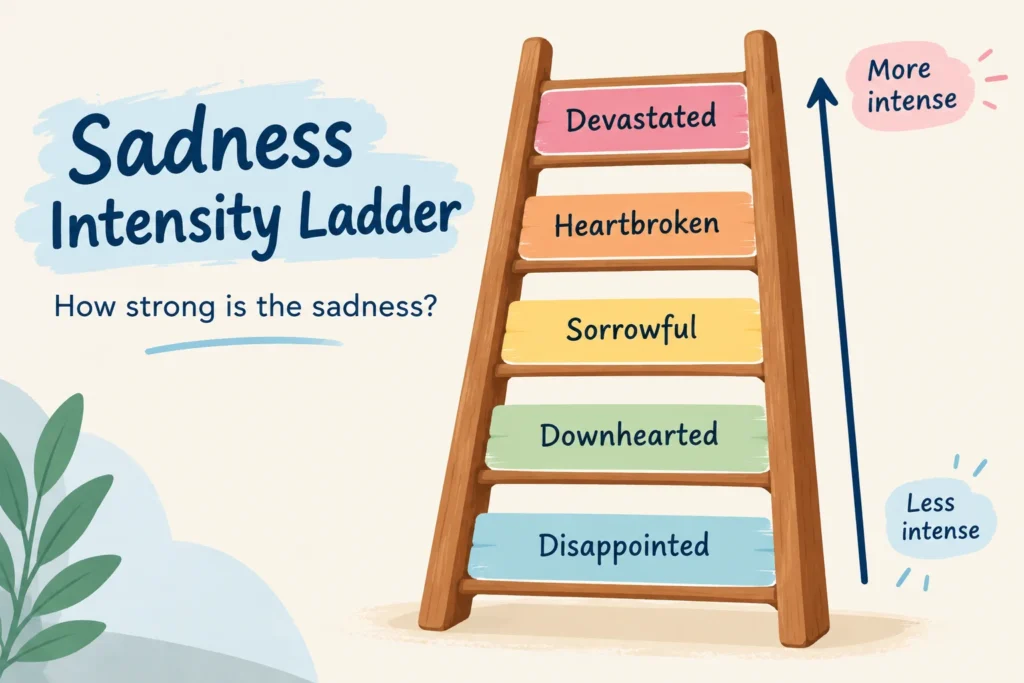
Intensity ladder: How strong is the sadness?
This ladder measures the intensity of emotional sadness, not the quality of a person or situation. It’s a rough guide because feelings differ from person to person.
Mild
Disappointed, a little sad
Moderate
Unhappy, downhearted
Strong
Miserable, sorrowful
Very intense
Heartbroken, devastated
The ladder is approximate: devastated often expresses a more overwhelming reaction than unhappy, but context matters. Melancholy is left off because it describes a particular quality of sadness rather than a clear degree of intensity.
Antonyms for Sad
The opposite of sad is usually happy, but other antonyms describe different forms of positive emotion. Use the word that matches the feeling you want to express.
| Antonym | Opposite of | How it differs | Example |
|---|---|---|---|
| Happy | Sad or unhappy | The broad, everyday opposite. | She felt happy with her results. |
| Cheerful | Glum or downhearted | Suggests a bright, positive mood or manner. | He greeted us with a cheerful smile. |
| Joyful | Sorrowful or deeply sad | Expresses strong happiness or delight. | The family shared a joyful celebration. |
| Hopeful | Despondent | Emphasizes belief that things may improve. | She remained hopeful about the future. |
| Optimistic | Gloomy or pessimistic | Focuses on expecting a favorable outcome. | He’s optimistic about his new job. |
| Content | Unhappy or dissatisfied | Suggests quiet satisfaction rather than excitement. | She felt content with her simple life. |
Remember: Happy and sad are broad opposites. Hopeful is not the direct opposite of every kind of sadness; it specifically contrasts with losing hope. Likewise, content describes satisfaction, not necessarily excitement or joy.
Sad vs. Similar Words
Some words related to sadness are easy to confuse. These comparisons show when each one works best.
| Word pair | Main difference | Example |
|---|---|---|
| Sad vs. unhappy | Sad often describes an emotional feeling; unhappy can also describe dissatisfaction with a situation. | “I’m sad about the goodbye.” / “I’m unhappy with my schedule.” |
| Sad vs. depressed | Sad can describe a temporary feeling. Depressed may describe a deeper or longer-lasting low mood and can also refer to a mental health condition. | “I’m sad that the trip ended.” / “He felt depressed about his circumstances.” |
| Sad vs. disappointed | Sad is broad; disappointed specifically involves unmet expectations. | “She was sad after the move.” / “She was disappointed by her score.” |
Don’t automatically replace sad with depressed. The latter can have clinical meaning, so it may communicate more than an ordinary emotion.
Which word should I choose?
- For everyday conversation, choose unhappy.
- For a setback, choose disappointed or dejected.
- For a breakup, choose heartbroken.
- For grief after a major loss, choose grief-stricken.
- For a gloomy outlook, choose gloomy or pessimistic.
- For quiet, reflective sadness, choose melancholy.
Using Sad and Its Synonyms in Context
The situation and audience help determine which word sounds natural. Here are examples for different settings.
Formal writing:
Use sorrowful, grief-stricken, or devastated when the situation supports their stronger meaning.
- The community was sorrowful after the passing of its longtime teacher.
- Residents were devastated by the destruction caused by the storm.
Casual conversation:
Use down, upset, glum, or unhappy.
- “I’m feeling a little down today.”
- “He was upset when his friend canceled their plans.”
Academic writing:
Choose words that explain the cause of the feeling.
- The participants were disappointed with the results.
- The novel portrays a sorrowful response to social isolation.
Creative writing:
Choose words that establish a mood or reveal a character’s feelings.
- A melancholy tune drifted through the empty house.
- She gave him a mournful look before closing the door.
Common collocations
A collocation is a combination of words that commonly appears together. Learning these pairings helps your English sound more natural.
| Natural phrase | Example |
|---|---|
| Sad news | We received some sad news yesterday. |
| Sad ending | The movie has a sad ending. |
| Deeply saddened | We were deeply saddened by the loss. |
| Bitterly disappointed | He was bitterly disappointed with the result. |
| Heartbroken over | She was heartbroken over the breakup. |
| Gloomy outlook | The report describes a gloomy economic outlook. |
| Mournful expression | He wore a mournful expression. |
Common Mistakes
Common mistakes to avoid
Mistake 1: Using every synonym as if it means exactly the same thing.
“She was devastated about a small delay” may sound exaggerated.
Better: “She was disappointed about the delay.”
Mistake 2: Confusing sadness with disappointment.
“I’m sad about my score” expresses an emotion, while “I’m disappointed with my score” points to an unmet expectation. Both can be correct, depending on the intended meaning.
Mistake 3: Treating “depressed” as a simple replacement for “sad.”
Depressed may suggest a more persistent or clinically significant condition. Use it carefully when describing another person’s experience.
Mistake 4: Choosing a formal word for casual speech.
“I am sorrowful because the bus is late” sounds unnatural in everyday conversation.
Better: “I’m upset because the bus is late.”
Related Words, Idioms, and Word Origin
Related words
- Sadness (noun): the feeling of being sad. Her sadness was clear.
- Sadly (adverb): in a sad manner, or used to introduce an unfortunate fact. Sadly, the event was canceled.
- Sadden (verb): to make someone sad. The news saddened everyone.
- Saddening (adjective): causing sadness. It was a saddening story.
Idioms for sadness
| Idiom | Meaning | Example |
|---|---|---|
| Down in the dumps | Feeling unhappy or low | He’s been down in the dumps since the move. |
| Feel blue | Feel sad; informal | I feel blue on rainy days. |
| Have a heavy heart | Feel deep sadness or worry | She left with a heavy heart. |
| Cry your eyes out | Cry a great deal | He cried his eyes out after the movie. |
| A long face | An expression of sadness or disappointment | Why the long face? |
Word origin
The word sad comes from Old English sæd, which originally carried meanings connected with being satisfied or having had enough. Its meaning later developed toward the modern sense of sorrow or unhappiness. For the historical details, consult the Cambridge Dictionary and a dedicated etymological dictionary.
Did you know?
The word sad can describe more than a person’s feelings. English speakers also use it for things that cause sorrow, such as sad news, and, informally, for something that seems neglected or unimpressive. Context determines which meaning is intended.
FAQs
What is the best synonym for sad?
Unhappy is usually the best general synonym. Use upset for an emotional reaction, disappointed when expectations aren’t met, or heartbroken for intense emotional pain.
What are five synonyms for sad?
Five useful synonyms are unhappy, sorrowful, gloomy, downhearted, and miserable. Each has a slightly different meaning, so choose according to the situation and intensity.
What is a stronger word for sad?
Devastated, heartbroken, and grief-stricken express intense sadness. Use devastated for a major emotional shock, heartbroken for deep emotional pain, and grief-stricken especially for grief after a death or major loss.
What is the opposite of sad?
The most common antonym is happy. Other opposites include cheerful, joyful, and content, depending on whether you mean a bright mood, strong happiness, or quiet satisfaction.
What is a formal word for sad?
Sorrowful is a formal or literary alternative. Grief-stricken suits intense grief, while mournful works well for expressions, voices, music, or behavior that communicate sorrow.
What is a word for feeling sad and disappointed?
Dejected is a good choice when disappointment leaves someone feeling low. Disheartened is also useful when a setback reduces confidence or hope.
How can I use sad in a sentence?
You can use sad before a noun or after a linking verb.
- Before a noun: “It was a sad story.”
- After a linking verb: “She feels sad today.”
- With an explanation: “I’m sad that our visit has ended.”
Quick Quiz
Choose the best answer for each question. Each question has one intended answer.
1. Which word is best for general unhappiness? UnhappyGrief-strickenJoyful
2. Which word best describes deep emotional pain after a breakup? CheerfulHeartbrokenContent
3. Which word describes sadness caused by unmet expectations? DisappointedMournfulOptimistic
4. Which word best describes a gloomy, pessimistic outlook? JoyfulGloomyContent
5. Which word means quietly satisfied rather than sad or dissatisfied? Devastated Despondent Content Check answers
Mini-challenge
Rewrite this sentence using a more precise synonym for sad:
“She was sad when she learned that her closest friend was moving away.”
One possible answer: “She was heartbroken when she learned that her closest friend was moving away.”
Why it works: Heartbroken emphasizes the deep emotional pain of losing daily contact with someone important. If she feels only mildly unhappy, upset or disappointed might be more appropriate.
Conclusion
The best alternative to sad depends on the feeling you want to communicate. Use unhappy for general sadness, downhearted for low spirits, disappointed for unmet expectations, melancholy for reflective sadness, and heartbroken for intense emotional pain.
Before choosing a synonym, ask yourself three questions:
- How strong is the feeling? Is it mild disappointment or overwhelming grief?
- What caused it? Was it a setback, a loss, or a general mood?
- Who is your audience? Would a casual word or a formal expression sound more natural?
These simple checks help you choose words that are clear, accurate, and natural in conversation, essays, and creative writing.
For more vocabulary guidance, explore these related Meanixer pages:
Synonyms for Bad — quality, harm, morals, a situation, food, a feeling, or a system?
Synonyms for Important — find precise alternatives for academic and everyday writing.
Antonyms for Important — learn how to express contrasting meanings.
You can also visit the Meanixer homepage to explore vocabulary resources and use its word-finding tools.

Leave a Reply