
The best antonyms for important are unimportant, minor, and trivial.
- Use unimportant for something that doesn’t matter. The color of the pen is unimportant.
- Use minor for something small compared to other things. It was only a minor problem.
- Use trivial for something not worth your attention. Don’t worry about trivial details.
Important has several meanings, so its opposite changes too. Something can be important because you need it, because it has a big effect, or because it’s first in rank. Pick the antonym that matches the meaning you want.
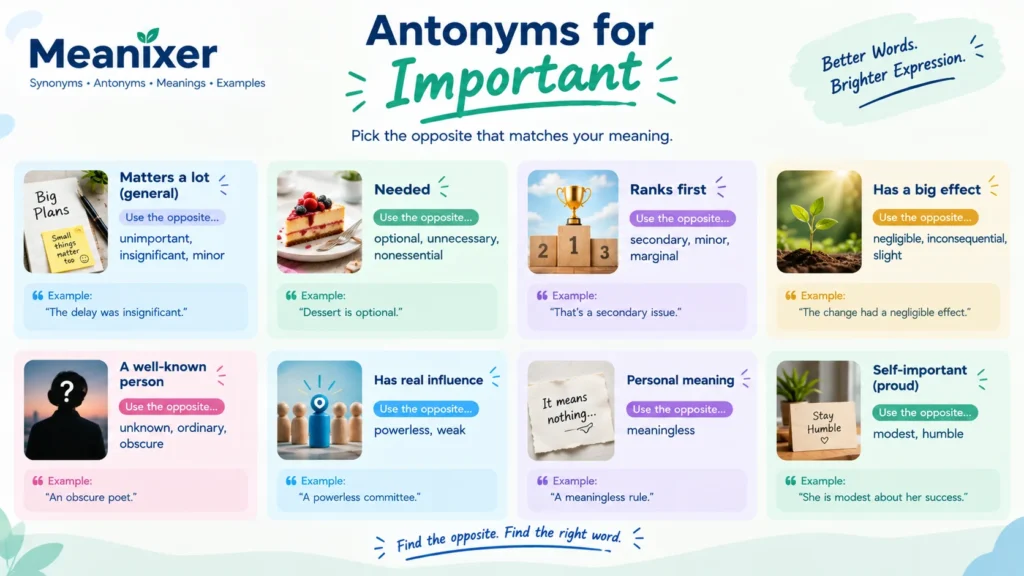
Pick the opposite that matches your meaning
| If “important” means… | Use the opposite… | Example |
|---|---|---|
| Matters a lot (general) | unimportant, insignificant, minor | “The delay was insignificant.” |
| Needed | optional, unnecessary, nonessential | “Dessert is optional.” |
| Ranks first | secondary, minor, marginal | “That’s a secondary issue.” |
| Has a big effect | negligible, inconsequential, slight | “The change had a negligible effect.” |
| A well-known person | unknown, ordinary, obscure | “An obscure poet.” |
| Has real influence | powerless, weak | “A powerless committee.” |
| Personal meaning | meaningless | “A meaningless rule.” |
| Self-important (proud) | modest, humble | “She is modest about her success.” |
How strong is each word?
Think of four levels:
- Light: slight, minor, secondary, marginal. A minor mistake.
- Medium: unimportant, insignificant, small, optional. An insignificant detail.
- Strong: trivial, negligible, trifling, petty, inconsequential. A trivial complaint.
- Very strong: worthless, meaningless, paltry. A worthless excuse.
The stronger the word, the more it dismisses the thing. Light words are gentler.
Casual or formal?
- Casual: no big deal, small stuff. It’s no big deal.
- Everyday: unimportant, minor, small. A minor change.
- Formal or school writing: insignificant, negligible, inconsequential, marginal. The difference was negligible.
- Work and business: low-priority, secondary, nonessential. Handle the low-priority tasks last.
Easy mix-ups
- Minor vs trivial: Minor means smaller than other things but it may still matter. Trivial means it isn’t worth attention. A minor injury still needs care. A trivial injury doesn’t.
- Unimportant vs unnecessary: Unimportant means it doesn’t matter. Unnecessary means you don’t need it. An unnecessary step wastes time.
- Negligible vs insignificant: Negligible means so small you can ignore it, usually a number or amount. Insignificant means it lacks meaning or effect. A negligible cost. An insignificant detail.
- Optional vs unimportant: Optional things can still be valuable. Insurance can be optional but still important.
A fun word story
Trivial comes from a crossroads. It comes from Latin trivialis, “common, commonplace,” literally “of the crossroads,” from trivium, “place where three roads meet.” Because a crossroads was a public place, the word came to mean common and ordinary. The sense “insignificant, trifling” is recorded in the 1590s. Think of a busy corner where ordinary talk happens, and you get the idea of “not important.” etymonline
Mistakes to avoid
1. Calling a person “unimportant.”
It sounds rude. If you mean someone isn’t famous, use unknown, obscure, or ordinary. For a kinder tone, try little-known or behind-the-scenes.
2. Using one opposite for every meaning.
Optional is the opposite of essential, but it’s the wrong opposite for a famous person. Match the word to the meaning.
3. Forgetting the “proud” meaning.
Important can also mean self-important. Merriam-Webster lists modest, humble, unpretentious, and unassuming as opposites for that sense.
4. Using a too-strong word.
Worthless means no value at all, not just “not important.” A minor detail is not a worthless detail.
5. Sounding rude.
Calling someone’s concern “trivial” can hurt, because it matters to them. Try small or minor, or say “that’s not the main issue.”
Explain why, not just that it’s unimportant
Saying “that’s unimportant” doesn’t help a reader. A reason does.
- Plain: “The font is unimportant.”
- Stronger word: “The font is trivial.”
- Reason added: “The font won’t change the result, so skip it and fix the text first.”
Quick check
- Which word fits best? “The cost is so small we can ignore it. It’s ___.” negligible / vital / pivotal
- Which word comes from a word meaning “crossroads”? trivial / minor / optional
- What’s the opposite of essential? optional / crucial / major
- What’s the opposite of a self-important person? humble / prominent / key
Answers: 1) negligible. 2) trivial. 3) optional. 4) humble.
FAQ
What is the best opposite of important?
Unimportant. Insignificant and minor also work. The detail is unimportant.
What is a stronger word than unimportant?
Trivial, negligible, or worthless. A negligible difference.
What is a formal antonym of important?
Insignificant, negligible, or inconsequential. An inconsequential remark.
What is the opposite of very important?
Of little importance, trivial, or negligible. A trivial issue.
What is the opposite of important at work?
Low-priority, secondary, or nonessential. This task is low-priority.
What is the opposite of an important person?
Unknown, obscure, or ordinary. unknown, obscure, anonymous, nameless, and uncelebrated.
What is the opposite of “more important”?
Less important, lesser, or secondary.
Related reading: Synonyms for Important · · Synonyms and Antonyms: · Try the Finder Tool

Leave a Reply