
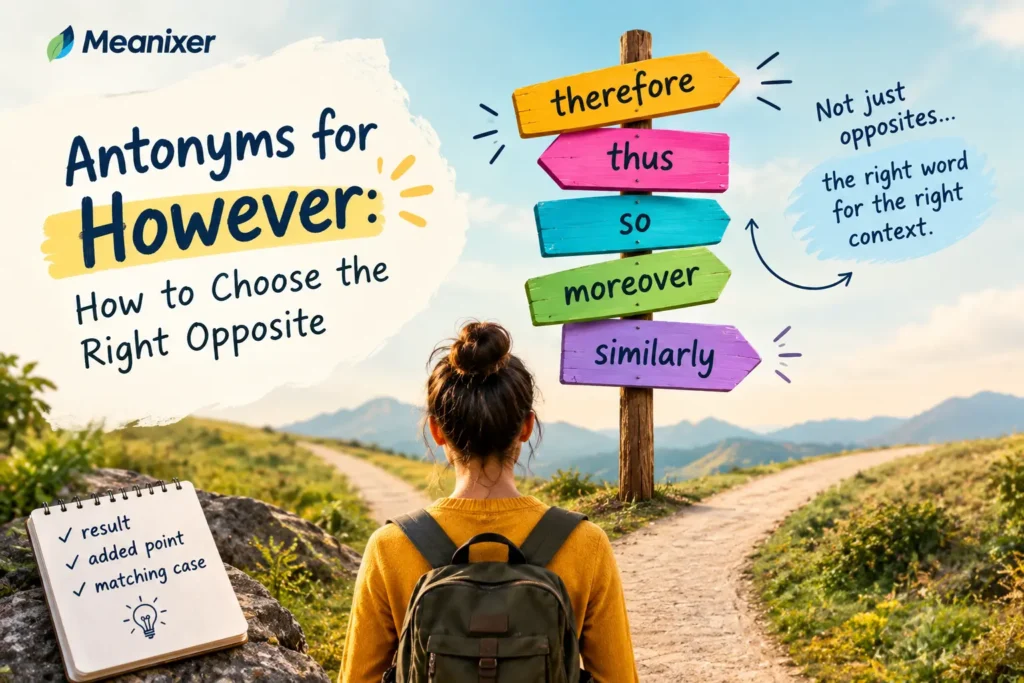
However is an adverb that signals a contrast. Its best antonyms are therefore, thus, and so, which show a result instead. Moreover and similarly are looser opposites that add or match an idea. The other two senses have no true antonyms.
Want longer lists? Try our synonym and antonym finder.
This guide to antonyms for however shows which opposite fits which sentence. However isn’t a word like “hot,” so its opposites work differently. Here’s how.
Meaning of However
Part of speech: adverb. Dictionary.com also lists it as a conjunction, as in “arrange your hours however you like.”
Pronunciation (US): hou-EV-er, /haʊˈɛvər/
Definition: despite that, or on the other hand. Dictionary.com also gives “to whatever extent,” “in whatever manner,” and a “how” use, as in a question.
However in a sentence:
- The flat is cheap; however, it’s far from work.
- Park however you like.
This page covers the contrast sense (the one with real opposites) and explains why the other two senses have none. If you want words that mean the same as however, see our synonyms for however. For the meaning of “meaning” itself, start with synonyms for meaning.
Antonyms for However
Here’s the key idea. However sends the second idea away from the first. A true opposite sends it forward. So the antonyms fall into three clusters: results, added points, and matching cases. A connotation is the feeling a word adds beyond its definition. Register means how formal or casual it sounds. A collocation is a pair of words that often go together.
Sense 1: Contrast (the only sense with true opposites)
One writer says the best antonyms make the second clause agree with the first, and names therefore, thus, and so. I add the other clusters as looser, functional opposites. Dictionaries don’t list them, so that’s a judgment call.
Cluster A: Result words (strongest opposites). The second idea follows from the first.
| Antonym | Opposite of | How it differs | Example |
|---|---|---|---|
| therefore (adv., formal-neutral) | however, nevertheless | Draws a conclusion from the first idea. | The battery was dead; therefore, the phone wouldn’t start. |
| thus (adv., formal) | however | Stiffer and common in academic writing. It also means “in this way.” | Costs fell by half; thus, profits rose. |
| so (conj., informal-neutral) | but | The casual choice. It needs no semicolon. | I was tired, so I went to bed early. |
| hence (adv., formal-literary) | however | Short and formal. It’s often used with a noun, as in “hence the name.” | The soup has no meat; hence, it suits vegetarians. |
| consequently (adv., formal) | nevertheless | Stresses a consequence, often in reports. | Rainfall was low; consequently, the harvest failed. |
| as a result (adv. phrase, neutral) | even so | Plain and clear. It’s great for ESL writing. | She practiced daily. As a result, her scores rose. |
Formality ladder (Cluster A only). This ladder measures one thing: how formal the word sounds. The order is rough, because dictionaries don’t rank these words.
so → as a result → therefore → thus → hence
I left off consequently because I can’t place it reliably. I also left off Clusters B and C because they do different jobs.
Cluster B: Added points (looser opposites). The second idea pushes in the same way as the first.
| Antonym | Opposite of | How it differs | Example |
|---|---|---|---|
| moreover (adv., formal) | however | Adds a stronger point in the same direction. | The flat is spacious; moreover, it’s near the station. |
| furthermore (adv., formal) | that said | Same job, a bit longer. It can add a negative point too. | The study was small; furthermore, it had no control group. |
| in addition (adv. phrase, neutral) | at the same time | Plain and flexible. | The ticket covers the museum. In addition, it includes lunch. |
| besides (adv., neutral-informal) | still | Adds a final, clinching reason. | I don’t want to go. Besides, it’s late. |
Cluster C: Matching cases. The second idea mirrors the first.
| Antonym | Opposite of | How it differs | Example |
|---|---|---|---|
| similarly (adv., neutral-formal) | by contrast | Shows that two cases are alike. | Sales rose in May. Similarly, they rose in June. |
| likewise (adv., formal) | on the other hand | “In the same way.” Slightly more formal. | She donates monthly; likewise, her brother helps at the shelter. |
Senses 2 and 3: No true antonym
However in “however you like” (in whatever way) and “However did you do it?” (surprise) has no true opposite. I’m not forcing one.
Which one should I choose?
- Ask what job however does: contrast, “in whatever way,” or surprise. Only contrast has opposites.
- Ask what should follow instead: a result, an added point, or a matching case.
- Match the register. So suits speech, and therefore suits essays.
- Check the grammar. So is a conjunction and takes a comma. Therefore and thus are adverbs and take a semicolon or period before them.
Words That Look Like Antonyms but Aren’t
- Conversely sounds like a reversal, but it still marks a contrast. It belongs with the synonyms, not here.
- Nevertheless, nonetheless, and still are synonyms of however, so they’re on the same team.
- Also adds an idea but doesn’t say whether it agrees. It’s too weak to be a true opposite.
- Instead and otherwise signal a replacement or “if not.” They do different jobs.
- In fact and indeed add emphasis, not agreement.
However vs. Its Opposites
| Pair | Key difference | Example |
|---|---|---|
| therefore vs. thus | Therefore says “for that reason.” Thus sounds more formal and can also mean “in this way.” | The data were weak; therefore, we retested. |
| therefore vs. so | Same idea, but so is casual and joins clauses with a comma. | We missed the bus, so we walked. |
| moreover vs. besides | Moreover adds a stronger point in formal writing. Besides adds a last, clinching reason in casual speech. | The plan is cheap; moreover, it’s fast. |
Punctuation patterns for the result words:
| Pattern | Rule | Example |
|---|---|---|
| ; therefore, | Between clauses. | It rained; therefore, we stayed in. |
| . Therefore, | New sentence. | It rained. Therefore, we stayed in. |
| , so | A comma only. | It rained, so we stayed in. |
Most style guides ask for a semicolon or period before therefore, so check yours.
Using However and Its Antonyms in Context
- Formal: The samples were contaminated; therefore, the team repeated the test.
- Casual: I missed the bus, so I walked.
- Academic: The sample was small; thus, the results may not apply to everyone.
- Business: Our costs rose; consequently, we raised prices.
- Technical: The cache was full. As a result, pages loaded slowly.
Collocations: and therefore, and thus, and so on, hence the name. Writing about key points? See synonyms for important.
Common Mistakes
Common mistakes box
- Wrong logic. A result word needs a real cause. “The pizza was cheap; therefore, it was cold” doesn’t connect.
- Comma splice. “It rained, therefore we left” joins two sentences with a comma. Use a semicolon, a period, or so.
- “So therefore.” It repeats the same job. Choose one.
- Overusing thus in casual writing. It can sound stiff. Use so or as a result.
- Treating moreover as a perfect opposite. It adds an idea in the same direction. It doesn’t show a result.
Related Words, Idioms, and Word Origin
Related words: therefore, thus, hence, consequently, moreover, similarly.
Idioms and fixed phrases:
- That’s why (informal) gives a reason in speech.
- It follows that (formal) shows logical steps.
- By the same token means “for the same reason.”
Etymology (word origin): dictionary.com says however was first recorded in 1350-1400 and comes from Middle English hou-ever. dictionary
Did you know?
Words like however are “function words,” so dictionaries often list no antonyms for them. One online dictionary we checked lists none. That’s why opposites for this word depend on the job it does.
FAQs
What is the opposite of however?
There’s no single opposite. Therefore, thus, and so are the best antonyms in the contrast sense, because they show a result.
What are the antonyms for however in a sentence?
“It rained; therefore, we stayed in.” The second idea follows from the first, instead of swerving away.
Is therefore the opposite of however?
Yes, in the contrast sense. However turns away from the first idea, and therefore follows from it.
Is moreover an antonym of however?
It’s a looser one. Moreover adds a point in the same direction, but it doesn’t show a result. Some writers wouldn’t call it an antonym.
Does however have an antonym in “however you like”?
No. This “in whatever way” sense has no true opposite.
What’s the difference between therefore, thus, and so?
They share a meaning but differ in tone and grammar. So is casual, therefore is neutral-formal, and thus is more formal.
What is a formal opposite of however?
Use therefore, thus, consequently, or moreover, depending on whether you mean a result or an added point.
Quick Quiz
- Which word best completes “The store was closed; ___, we bought nothing”?
a) however b) therefore c) nevertheless d) by contrast - Which sentence is punctuated correctly?
a) It rained, therefore we left. b) It rained; therefore, we left. c) It rained therefore we left. d) It rained; therefore we, left. - Which one-word result link works with just a comma?
a) therefore b) thus c) so d) hence - Which word adds a point in the same direction, as a looser opposite of however?
a) moreover b) nevertheless c) still d) though - Which word is NOT an antonym of however?
a) thus b) so c) consequently d) conversely
Mini-challenge: Rewrite with a more formal opposite of however: “It was raining, so we stayed inside.”
Answers: 1) a is wrong, so b. 2) b. 3) c. 4) a. 5) d. Mini-challenge: “It was raining; therefore, we stayed inside.” (Consequently also works.)
Conclusion:
Your Next Step Choose by job first, then by register. Use so for speech, therefore for essays, and when you’re adding a point.
Want more help with transitions? Browse our Meanixer.com for the full library.

Leave a Reply