
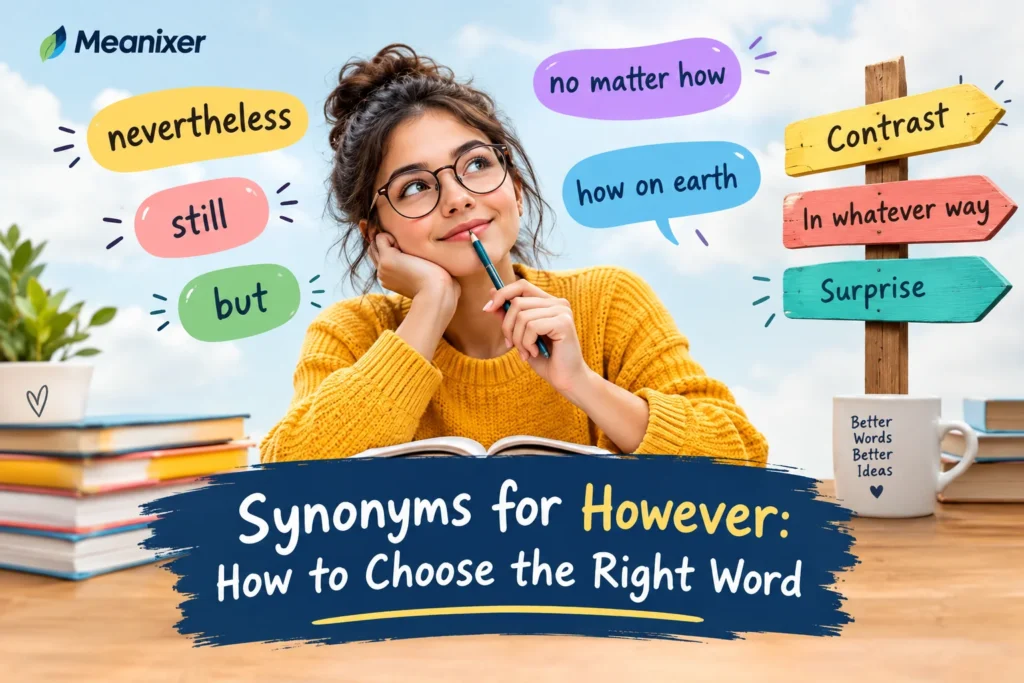
However is an adverb that signals a contrast with what you just said. For that main sense, use nevertheless, still, or but. Other senses need other words: no matter how for “in whatever way,” and how on earth for surprise. Top antonyms: therefore, thus, and so.
Need more options? Try our synonym and antonym finder.
This guide to synonyms for however shows which word fits which sentence, so you can stop repeating the same transition.
Meaning of However
Part of speech: adverb. In its contrast sense, it’s a conjunctive adverb, a word that links two sentences or independent clauses. Some dictionaries also list a conjunction use. [Editor: verify.]
Pronunciation (US): hou-EV-er, /haʊˈɛvər/.
Definition: in spite of that, or on the other hand. It also means “in whatever way” or “to whatever degree.”
Word forms: however has no endings. Related words come from the same -ever family: whatever, whenever, wherever, and whoever.
However in a sentence:
- The hike was long; however, the view was worth it.
- Arrange the chairs however you like.
This page covers three senses: (1) contrast or concession, (2) “in whatever way or degree,” and (3) surprise in a question. Sense 1 is what most readers mean, so it gets the most depth. There’s no specialist sense that needs its own synonyms.
Synonyms for However
Synonyms aren’t swappable parts. Each word has its own connotation, the feeling it adds beyond its dictionary meaning. Register means how formal or casual a word sounds. A collocation is a pair of words that often go together, like “however much.”
Sense 1: Contrast or concession
These words differ in kind: some join sentences, some sit inside them, and some admit a point while holding firm. I’m grouping them in three clusters.
Cluster A: Short joiners. These are conjunctions (joining words), so they work differently from however, which is an adverb. But and however belong to different word classes. That changes the punctuation.
| Word | How it differs | Example |
|---|---|---|
| but (conj., neutral) | The simplest and most direct choice. It joins clauses, so no semicolon is needed. | The plan is simple, but it takes time. |
| yet (conj., neutral-formal) | A little more formal. It often suggests a surprising contrast. | The test was hard, yet most students passed. |
| although (conj., neutral) | Starts a clause, so you must rebuild the sentence. | Although the plan is risky, we’ll try it. |
| though (adv. or conj., informal-neutral) | At the end of a sentence, it acts like a soft however. | The food was good. The service was slow, though. |
Cluster B: Concession (admits a point, then goes on anyway).
| Word | How it differs | Example |
|---|---|---|
| nevertheless (adv., formal) | The second point holds despite the first. | The road was closed; nevertheless, we arrived on time. |
| nonetheless (adv., formal) | Same meaning as nevertheless, and many writers treat them as the same. | The team lost. Nonetheless, they kept smiling. |
| still (adv., neutral) | Plainer and warmer. Good for essays and speech. | It’s expensive. Still, it’s worth the price. |
| even so (adv. phrase, neutral) | Conversational and clear. | The room was small. Even so, we loved it. |
| all the same (adv. phrase, neutral-informal) | Personal and a bit reflective. | I know it’s risky. All the same, I want to try. |
| notwithstanding (adv., very formal) | Legal or official in tone. As an adverb it’s rare, since it’s usually a preposition. | The risks were high; notwithstanding, the board approved. |
| howbeit (adv., archaic) | Old-fashioned. Avoid it in modern writing. | He promised to return; howbeit, he never did. |
Cluster C: Side-by-side contrast.
| Word | How it differs | Example |
|---|---|---|
| on the other hand (adv. phrase, neutral) | Sets two ideas next to each other. | Cooking at home is cheap. On the other hand, it takes time. |
| by contrast (adv. phrase, neutral-formal) | Puts two facts against each other, often with numbers. | Sales rose in May. By contrast, they fell in June. |
| that said (adv. phrase, informal-neutral) | Adds a balancing note. | It’s a fine phone. That said, the battery is weak. |
| at the same time (adv. phrase, neutral) | Adds a second point that pulls the other way. | The job pays well. At the same time, it takes your weekends. |
Formality ladder. This ladder measures one thing: how formal the word sounds. The order is rough, because dictionaries don’t rank these words.
but → still → however → nevertheless → notwithstanding
I left off though, although, and yet because their formality shifts with their place in the sentence. I also left off the phrases (on the other hand, that said) because they work as units, not as single words.
Related, not true synonyms: conversely (reverses a relationship, which is narrower than contrast), instead (replaces one thing with another), on the contrary (rejects what came before), despite and in spite of (prepositions that need a noun).
Sense 2: In whatever way or to whatever degree
Think “however you like” or “however hard you try.” There’s no comma after however here.
| Word | How it differs | Example |
|---|---|---|
| no matter how (phrase, neutral) | The clearest swap. Used for degree. | No matter how hard I try, I can’t focus. |
| regardless of how (phrase, neutral-formal) | A bit more formal. | Finish by Friday, regardless of how you do it. |
| whichever way (phrase, neutral) | Used for manner, not degree. It sounds odd with “hard.” | Do it whichever way you prefer. |
Sense 3: Surprise in a question
Dictionary.com includes this use, as in a question asking how someone managed something. dictionary
| Word | How it differs | Example |
|---|---|---|
| how on earth (phrase, informal-neutral) | Shows surprise or disbelief. | How on earth did you finish so fast? |
| how in the world (phrase, informal) | Same meaning, a little folksier. | How in the world did you find me? |
Which one should I choose?
- Ask what however is doing: contrasting, conceding, or meaning “in any way”?
- Jump to that sense and read the “How it differs” column.
- Check the register. Still and even so suit blogs and speech. Nevertheless suits reports.
- Check the grammar. But and although change your punctuation, so rewrite the sentence if you swap them in.
Antonyms for However
In the contrast sense, an antonym makes the second idea follow the first. One writer names therefore, thus, and so as the best antonyms. Senses 2 and 3 have no true antonym. interestingliterature
| Antonym | Opposite of | How it differs | Example |
|---|---|---|---|
| therefore (adv., formal-neutral) | however, nevertheless | Signals a result. | The road is closed; therefore, we’ll take the bus. |
| thus (adv., formal) | however | Signals “as a result.” | The data were incomplete; thus, we waited. |
| so (conj. or adv., informal-neutral) | but | A casual result word. | It was raining, so we stayed in. |
| consequently (adv., formal) | nevertheless | Shows a consequence. | Costs rose; consequently, prices went up. |
| as a result (phrase, neutral) | even so | Shows cause and effect. | She trained daily. As a result, she improved. |
| moreover (adv., formal) | however | Adds support in the same direction. | The plan is cheap; moreover, it’s fast. |
| similarly (adv., neutral-formal) | by contrast | Shows likeness, not contrast. | Sales rose in May. Similarly, they rose in June. |
Near-misses. Instead signals a replacement, not agreement. Also adds an idea without saying whether it agrees. Despite is a synonym-like word, not an opposite.
However vs. Similar Words
| Pair | Key difference | Example |
|---|---|---|
| however vs. but | However is an adverb, so it needs a semicolon or period before it. But is a conjunction. | It’s cheap; however, it’s slow. / It’s cheap, but it’s slow. |
| however vs. nevertheless | Nevertheless means “despite that.” However just means “in contrast.” | The path was steep; nevertheless, we climbed it. |
| however vs. although | Although starts a clause. However starts a new one. | Although it’s late, we’ll stay. / It’s late; however, we’ll stay. |
Punctuation patterns for however:
| Pattern | Rule | Example |
|---|---|---|
| ; however, | Contrast sense, between clauses. | I like it; however, it’s pricey. |
| . However, | Contrast sense, new sentence. | I like it. However, it’s pricey. |
| , however, | Contrast sense, mid-sentence. | It is, however, pricey. |
| however + word | “In whatever way or degree.” No comma. | However hard you try, don’t rush. |
Using However and Its Synonyms in Context
- Formal: The pilot program worked; nevertheless, the board wants more data.
- Casual: It’s pricey. Still, I want it.
- Academic: Early studies showed gains; however, later trials found none.
- Business email: The update fixes the bug. That said, it slows startup time.
Collocations: however much, however long, however hard, however you like. “However much” is more natural than “however many much.”
Common Mistakes
Common mistakes box
- Comma splice. “It’s cheap, however it’s slow” joins two sentences with only a comma. Use a semicolon, a period, or but. Most style guides ask for this, so check yours.
- Double connectors. “Although it’s cheap, but it’s slow” is a real error. Use one: Although it’s cheap, it’s slow or It’s cheap, but it’s slow.
- “But however.” It repeats the same job. Choose one.
- A comma in the wrong sense. “However, you like” breaks “in whatever way.” Write “however you like.”
- Starting every sentence with however. It’s easy to overuse. Rotate still, even so, that said, or restructure the sentence. proofed
Repetition is a problem with verbs too. When “make” shows up everywhere, try synonyms for create.
Related Words, Idioms, and Word Origin
Related words: whatever, whenever, wherever, whoever, however much.
Idioms and fixed phrases:
- Be that as it may is a formal way to say “even so.”
- Having said that is a friendly way to introduce a balancing point.
- On the flip side (informal) means “from the other side of the issue.”
Etymology (word origin): Dictionary.com says it was first recorded in 1350-1400 and comes from the Middle English hou-ever.
Did you know? However is built from two plain words, how and ever. Many -ever words work this way: whatever, whenever, and wherever all add “ever” to a question word.
For definitions and usage notes, check Merriam-Webster [link to add] or Oxford Learner’s Dictionaries [link to add].
FAQs
What are the best synonyms for however?
It depends on the sense. Use nevertheless, still, or but for contrast, no matter how for “in whatever way,” and how on earth for surprise.
What is another word for however at the start of a sentence?
Try Still, Even so, That said, Nevertheless, or On the other hand. Pick by how formal your writing is.
What is a formal synonym for however?
Use nevertheless or nonetheless. Notwithstanding is very formal and rare as an adverb. [Editor: verify.]
Is “but” the same as “however”?
They’re close in meaning but not in grammar. But is a conjunction, so it can follow a comma. However is an adverb, so it needs stronger punctuation before it.
What is the opposite of however?
Therefore, thus, and so are the usual opposites. Moreover is another, since it adds an idea in the same direction.
Can you start a sentence with however?
Yes. It’s common in formal writing, and a comma follows it in the contrast sense. Some style guides discourage starting with but, so check yours.
How do you punctuate however?
In the contrast sense, put a semicolon or period before it and a comma after it. In the “in whatever way” sense, don’t use a comma.
Quick Quiz
- Which transition best fits “The test was hard. ___, most students passed”?
a) Therefore b) Even so c) Moreover d) Similarly - Which sentence is punctuated correctly?
a) It’s cheap, however it’s slow. b) It’s cheap; however, it’s slow. c) It’s cheap however it’s slow. d) It’s cheap; however it’s, slow. - Which word signals a result, the opposite of however?
a) therefore b) nonetheless c) still d) yet - Which phrase can replace however in “Do it however you like”?
a) nevertheless b) whichever way c) therefore d) that said - Which phrase can replace however in “However did you finish so fast?”
a) How on earth b) Even so c) That said d) By contrast
Mini-challenge: Rewrite with a more formal synonym: “The path was steep. However, we reached the top.”
Answers: 1) b. 2) b. 3) a. 4) b. 5) a. Mini-challenge: “The path was steep. Nevertheless, we reached the top.” (Nonetheless also works.)
Conclusion
Choose by sense, then grammar, then register. Use still for a warm tone, nevertheless for a formal one, and but for a simple link.
Keep building your vocabulary with synonyms for love, or return to Meanixer.com for more guides.

Leave a Reply