
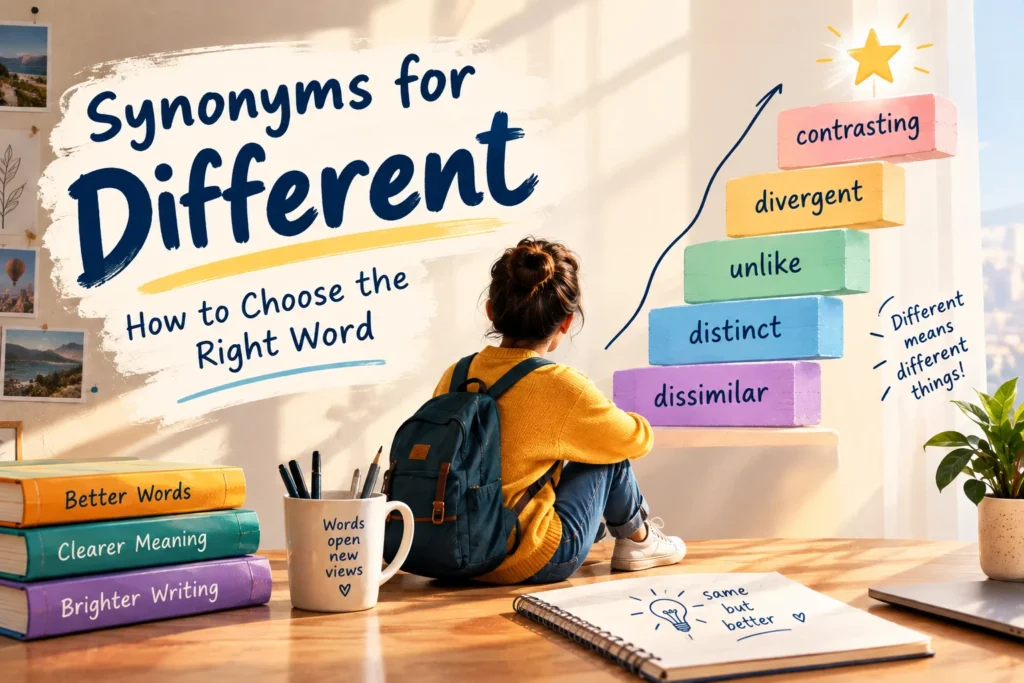
Different is an adjective meaning not the same as something else.
For that Main sense, use Dissimilar or Distinct.
Other senses need other words: Various for Several kinds,
Unconventional for Unusual, and
Altered for change.
Top antonyms: same, alike, and similar.
Want the full list? Try our synonym and antonym finder.
This guide to synonyms for different shows you which word fits which job, so you stop guessing from a long list.
Meaning of Different
Part of speech: adjective
Pronunciation (US): DIF-er-ent or DIF-rent /ˈdɪf(ə)rənt/ [editor: verify IPA]
Definition: not the same as another. It can also mean separate, several, unusual, or changed.
Word forms: the adverb is differently, the noun is difference, and the verb is differ. The verb differentiate means to tell things apart. Adjectives don’t take plural endings, so you say “different ideas,” never “differents ideas.”
Different in a sentence:
- My brother and I have different tastes in music.
- She came back from the trip a different person.
This page covers four senses: (1) not the same, (2) separate or several, (3) unusual, and (4) changed. Sense 1 is what most readers mean, so it gets the most depth. There’s no specialist sense that needs its own synonyms.
Synonyms for Different
Synonyms aren’t swappable parts. Each word has its own connotation, the feeling it adds beyond its dictionary meaning. Register means how formal or casual a word sounds. Collocations are words that often go together, like “vastly different.”
Sense 1: Not the same (most searched)
These words differ in kind, not just strength. Some stress the size of the gap, some the direction, and some how clearly you can see it. So I’m grouping them, not ranking them.
| Word | How it differs | Example |
|---|---|---|
| dissimilar (adj., neutral-formal) | The plain, formal “not alike.” It’s often followed by to. | Their teaching styles are dissimilar. |
| distinct (adj., neutral-formal) | Clearly different and easy to tell apart. | The two species have distinct songs. |
| unlike (adj., neutral) | Used after a verb, as in “are quite unlike.” It sounds odd before a noun. | The brothers are unlike in almost every way. |
| disparate (adj., formal) | So different in kind that they seem unrelated. | The report ties together disparate sources. |
| divergent (adj., formal) | Starting alike, then moving apart. | The two groups took divergent paths after college. |
| contrasting (adj., neutral) | Different in a way that shows when placed side by side. | The room mixes contrasting colors. |
Gap size, roughly: dissimilar and distinct cover small to large gaps. Disparate sits at the far end because it means different in kind. I’m not building a ladder, because divergent (direction) and contrasting (side-by-side) don’t measure the same thing.
Related, not true synonyms: unique (one of a kind), distinctive (marks something as itself), another (one more, not necessarily unlike).
Sense 2: Separate or several
Think “three different answers” or “different schools.”
| Word | How it differs | Example |
|---|---|---|
| various (adj., neutral) | Several kinds or examples, with no comment on the range. | She tried various approaches. |
| diverse (adj., neutral-formal) | A wide range of kinds, often people or ideas. Positive. | The school has a diverse student body. |
| varied (adj., neutral) | Contains different kinds, such as a menu or a career. | He has a varied career in sales and teaching. |
| separate (adj., neutral) | Not the same one, not joined. | The two families live in separate towns. |
| assorted (adj., neutral) | A mixed set, often of small items. Casual. | He packed assorted snacks for the trip. |
Sense 3: Unusual
Think “a different kind of restaurant.” Dictionary.com notes that this meaning is well established except in the most formal American English. In essays, choose a more exact word. dictionary
| Word | How it differs | Example |
|---|---|---|
| unusual (adj., neutral) | The plain choice. It doesn’t say good or bad. | That’s an unusual choice for a wedding. |
| unconventional (adj., neutral-formal) | Breaks from the usual rules or habits. | She took an unconventional route into law. |
| original (adj., neutral, positive) | New and not copied. | He pitched an original idea. |
| novel (adj., neutral-formal) | New and unlike earlier ones. | The team proposed a novel solution. |
| offbeat (adj., informal) | Slightly strange in a fun way. | We watched an offbeat comedy. |
| quirky (adj., informal) | Charmingly odd. | They run a quirky little café. |
| peculiar (adj., neutral) | Strange, and often a bit negative. | A peculiar smell filled the hall. |
Need a verb for making something original? Try synonyms for create. If you mean “impressive” instead of “odd,” see synonyms for amazing.
Sense 4: Changed
Think “She’s different now.”
| Word | How it differs | Example |
|---|---|---|
| changed (adj., neutral) | The plain word for “not as before.” | She seems like a changed person. |
| altered (adj., neutral-formal) | Modified, often in a specific way. | We worked from an altered schedule. |
| transformed (adj., neutral) | Changed completely. Stronger than changed. | The transformed city has new parks. |
| new (adj., neutral) | Feels like a fresh version of someone. | I feel like a new person after the break. |
Which one should I choose?
- Ask what you mean: not alike, several kinds, unusual, or changed?
- Jump to that sense and read the “How it differs” column.
- Check the register. Quirky suits a blog, and disparate suits a report.
- Decide the feel. Original praises, peculiar hints at doubt, and distinct just states a fact.
Antonyms for Different
The opposite of different depends on the sense. Each antonym below is paired with the word it contrasts with.
| Antonym | Opposite of | How it differs | Example |
|---|---|---|---|
| same (adj., neutral) | different (senses 1 and 2) | The plain opposite. | We bought the same shirt. |
| identical (adj., neutral) | dissimilar, distinct | Exactly alike. | The twins wore identical coats. |
| alike (adj., neutral) | unlike, dissimilar | Used after a verb. | The two songs sound alike. |
| similar (adj., neutral) | dissimilar | Alike in some ways, so it’s a mild opposite. | Their views are similar. |
| uniform (adj., formal) | diverse, varied | The same throughout. | The houses are uniform in size. |
| conventional (adj., neutral) | unconventional | Follows the usual way. | She chose a conventional career. |
| ordinary (adj., neutral) | unusual | Nothing special. | It was an ordinary Tuesday. |
| unchanged (adj., neutral) | changed, altered | Still as before. | The recipe stays unchanged. |
Near-misses. Indifferent looks like a relative but means “not caring.” Indistinct means blurry, so it isn’t the opposite of distinct in the “separate” way. Similar is weaker than a true opposite. There’s no clean antonym for novel or original that works every time.
Different vs. Similar Words
| Pair | Key difference | Example |
|---|---|---|
| different vs. distinct | Different just says “not the same.” Distinct adds “easy to tell apart.” | Two different plans; two distinct accents. |
| various vs. diverse | Various counts kinds. Diverse stresses a wide range, often of people. | Various answers; a diverse team. |
| different vs. unique | Different compares. Unique means one of a kind. | A different recipe; a unique painting. |
The preposition question: Dictionary.com says from is now the most widely accepted word after different. Usage guides disagree on the other two, so check your style guide.
A person can seem different because their mood changed. For those shifts, see synonyms for happy and synonyms for sad.
| Phrase | How it’s used | Example |
|---|---|---|
| different from | Safest in exams and formal writing. | My plan is different from yours. |
| different to | Common in British English. Some readers find it less acceptable. | Life here is different to life in London. |
| different than | Standard in American English, especially before a clause. | It was different than I expected. |
Using Different and Its Synonyms in Context
- Formal: The two studies reached divergent conclusions.
- Casual: Her new haircut looks totally different.
- Academic: The authors compare disparate data sources.
- Technical: The two samples show distinct chemical signatures.
Collocations: completely different, vastly different, entirely different, markedly different, a different story, different from. You say “vastly different,” not “hugely distinct.”
Common Mistakes
Common mistakes box
- “Different with.” This is a real error. Use different from.
- “Differents ideas.” Adjectives don’t add -s. Say “different ideas.”
- “Different than” in formal essays. It’s standard in US English but not universally liked. When unsure, use from.
- Spelling. It’s different, with two fs and -ent. Typos like diffrent are common.
- “Very different” every time. Try disparate or distinct for variety.
Related Words, Idioms, and Word Origin
Related words: differ, difference, differently, differentiate.
Idioms:
- A different story means a separate matter.
- Different strokes for different folks (informal) means people have different tastes.
- On a different note means “changing the subject.”
- Worlds apart means extremely different.
Etymology (word origin): dictionaries trace different to Latin. [Editor: confirm the root.]
Did you know? Different and indifferent share a root, but they drifted far apart. Indifferent now means “not caring.” That’s why it isn’t an antonym.
FAQs
What are the best synonyms for different?
It depends on the sense. Use dissimilar or distinct for “not the same,” various for several kinds, unconventional for unusual, and altered for changed.
What is another word for different?
Distinct fits most cases where you mean “clearly not the same.” For something unusual, use unconventional.
What is a more formal word for different?
Use dissimilar, distinct, divergent, or disparate. Pick by meaning, not just by sound.
What is a synonym for “very different” or “completely different”?
Disparate or worlds apart works. You can also say “markedly different.”
What is the opposite of different?
Same is the plain opposite. Use identical for “exactly alike” and uniform for “no variety.”
Is it “different from,” “different to,” or “different than”?
Use from in exams and formal writing. To is common in British English, and than is standard in American English.
What’s a positive word for different?
Try original, novel, or unconventional.
Quick Quiz
- Which word best fits “Her design is ___, unlike anything on the market”?
a) unconventional b) identical c) similar d) uniform - Which word best fits “The festival draws a ___ crowd from many countries”?
a) identical b) diverse c) alike d) same - Which word is the plain opposite of different in “These two phones are different”?
a) same b) divergent c) distinct d) various - Which preposition is the safest choice after different in formal writing?
a) with b) from c) of d) at - Which word fits “He came back from the trip a ___ man”?
a) uniform b) identical c) transformed d) similar
Mini-challenge: Rewrite with a stronger synonym: “The two plans are very different.”
Answers: 1) a. 2) b. 3) a. 4) b. 5) c. Mini-challenge: “The two plans are disparate.”
Conclusion
Choose by sense first, then by register. Use distinct for clear differences, various for several kinds, and unconventional for something unusual.
Next, explore distinct, similar, and unusual.
Want more help with word choice? Browse our vocabulary tips, or try our synonym and antonym finder.

Leave a Reply